Suspend and Overhaul Bottle Bill

LETTERS TO THE EDITOR
The views expressed here do not necessarily represent or reflect the views of the Northern California Recycling Association.

SUSPEND AND OVERHAUL CALIFORNIA’S BEVERAGE CONTAINER REDEMPTION PROGRAM
By Aaron Forkash. Aaron Metals Company, in Oakland since 1976 and in Hayward since 2011, California State Certified Recycling Center, PR 0026/RC 0926, 5/11/2020

The State of California must immediately suspend the collection of redemption deposits and begin overhauling the California Beverage Container Recycling and Litter Reduction Act.

Popularly known as the Bottle Bill, the underlying legislation has been exposed by the Coronavirus pandemic for its manifold faults; just as the pandemic reveals some of our nation’s social and economic injustices.

The statewide shelter-in-place order prompted by the pandemic prevents consumers from redeeming recyclable materials at nearly non-existent redemption centers. Consumers have no reason to risk infection and violate the shelter-in-place order as there is now wide-spread access to curbside collection.

Simply put: If there’s nowhere to redeem, suspend the collection scheme.

The Bottle Bill has been in a steady and irreversible decline since the late ‘80s as the economic growth of California’s urban regions forced the closure of redemption centers.

The last few years revealed what are now major flaws with California’s buy-back system: the gradual and inevitable disappearance of the supermarket redemption sites, the closure of small recycling centers and the cessation of larger recycling companies participating in the unprofitable program. All amplified, no doubt, thanks to the risk of infection related to the Coronavirus pandemic – since viral droplets live in saliva and in the container’s residual moisture. Add to this increasing operational costs and the contemporaneous refusal of China to receive and use the contaminated scrap material.

Ultimately, however, curbside pick up — being a much greener option — led to the Bottle Bill’s irreversible undoing.

According to a 2019 Los Angeles Times article, in 2018 consumers left $308 million in unredeemed deposits on the table. The story clearly supports my contention that the lack of redemption centers limits a consumer’s access to the collected deposits.

The system relies on California’s established recycling industry. In fact, California’s recycling centers once operated on the front lines of the State’s buy-back program. However, rather than defending and working to strengthen the State’s recycling industry, CalRecycle, the regulatory agency enforcing the program, has been unsupportive.

CalRecycle appears more focused on preventing and prosecuting fraud. In the aftermath of one of their crime-fighting ventures, a CalRecycle rep had the temerity to be quoted thusly: “Defrauding the recycling fund is stealing from the state of California and its citizens.” Ironic, isn’t it, considering the hundred millions of dollars California citizens can no longer collect due to the reduced numbers of recycling sites.

CalRecycle’s staff attorneys should have brought legal action against cities denying permits for new recycling sites and existing recycling sites trying to expand. As well, they should have aggressively responded to residents who lodged nuisance complaints against the remaining sites — not chasing down out-of-state cans.

Now is the time for Gov. Gavin Newsom to act. As the State tentatively takes steps to ‘reopen’ let’s not return to a flawed system. The state cannot be allowed to continue to collect deposits without giving Californians opportunities for redemption.

By executive order, the governor is in a position to suspend the collection scheme. The purpose? To motivate CalRecycle and the Legislature to dismantle and reconfigure the Bottle Bill to a producer responsible model which mandates the phase-out of single-use plastic and glass. Within such a framework, the beverage maker is responsible for the use-life of each container it produces; tracking its location from distribution, purchase, disposal and return. The new system must promote the use of (disinfectable) reusable containers.

The recycling industry stands ready and willing to partner with CalRecycle to build a robust recycling system worthy of the consumers it serves.

California continues to collect deposits knowing access to redeem recyclables is inadequate. Let’s stop it now!

Keeping COVID-19 At Bay While Recycling

WHILE RECYCLING WE KEPT COVID -19 AT BAY, STILL SOCIALIZED AND IT WAS FUN
By Daniel Knapp, CEO of Urban Ore, Inc., a Materials Recovery Facility now celebrating its 40th year in Berkeley, California
On my way home from an essential errand today, I got off the I-80 freeway at Gilman in Berkeley to check out the status of Community Conservation Center’s (CCC’s) recycling dropoff, buyback, and materials processing facility. I had a pickup full of cans, bottles, and paper, and in previous days I’d driven by at least twice to no avail as the weight built up and the truck’s handling got more sluggish. Recycling is an “Essential Business” but CCC had been closed to the public. Had they reopened yet?

I turned left onto Second Street, and – great! CCC staff had reopened at least the dropoff function, so I could recycle again. They had made a nice adaptation to the shelter in place order. It was simple: they just opened their two long rolling gates on Second Street and skidded in five-yard bins to plug the gaps. Each bin had a label: “mixed paper,” “cardboard,” “green glass,” and so on through six choices. They had rigged an impromptu dropoff capability that we patrons could access from outside the site.

Inside the fence, CCC was still closed to the public. But staff were busily processing recyclables from commercial and residential curbside service. They were making bales.

I parked next to the three paper bins and put the first of seven or eight heavy bags of paper into the mixed paper. I’m slow because I save the bags for another use, and it takes time to fold them properly.

Meanwhile another patron joined me at the bins, a woman maybe in her sixties. (I’m 80.) We started talking about how nice it was to be able to get rid of our stuff again. I told her I still work for Urban Ore. “I know Urban Ore well,” she said. Meanwhile, a CCC forklift driver had come over, stopped on the other side of the bin row, and was looking at me. He looked like he might want to pull the bin I was dumping into. Then he and I recognized each other. It was none other than Michael Ware, the Supervising Manager at CCC.
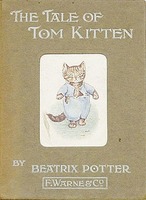
Just then a talisman at right appeared. It unlocked the questions of responsibility and what is essential.

Earlier I had spotted a tiny hardbound children’s book by Beatrix Potter on top of the mixed paper in the bin, but it was too low and far away for me to reach. I had commented about it to the lady and said it was a shame it was in there with the recycling. She looked and immediately walked over to a different CCC employee who was working on a car on the other side of the fence. She told him there was a nice book in the mixed-paper bin. He just kind of fended her off, telling her “not to worry about it.” She rolled her eyes and resumed her outside-the-fence recycling.

Meanwhile, Michael Ware and I had started talking. He got off the forklift to get closer, but we were still the required six feet away.

Then the lady told Mike about the tiny Beatrix Potter book. He looked into the bin, spotted it, then levered himself up with his body draped over the edge like a beach towel. It took him about five seconds to retrieve the book; he was very agile. Back upright on the ground, he held it up and looked at it. I asked if he had a kid he could give it to. He said no, his youngest was sixteen. He reached across the bin, offering it to my recycling companion. She asked me to take it to Urban Ore, so I accepted it and brought it home.

At home I took a closer look at the book. It’s in good condition, first copyrighted in 1907, renewed in 1935. This is the 17th printing. Judging from the coated paper and high-quality print job, it’s maybe 35-40 years old. The title is The Tale of Tom Kitten. The author and illustrator was indeed Beatrix Potter, author of The Tale of Peter Rabbit, and Tom Kitten was the 11th of her 23 tales. The publisher was Frederick Warne & Co. I placed it in the “going to Urban Ore” box we keep by the front door.

I have no idea what it’s worth, but I’ll bet it might fetch a price of between $4 and $8 at our bookstore. Any price over a penny would be a vast multiple of the mixed-paper price if it had been sold as scrap.

Restore the CCC buyback service? When and how is the question. 

Then Jeff Belchamber, General Manager of CCC, left what he was doing and walked over to join the conversation. He noted that CCC had decided they could get their dropoff line going again, but were keeping the public out and the Buyback closed based on a directive from the Zero Waste Division.

He said there was some advantage to being closed, because they were able to get necessary maintenance done. I suggested that CCC could tell the City that it is an “Essential Business” for all its functions, including the Buyback that gives people back their nickel deposits, because it provides environmentally superior disposal services compared to wasting. He looked a bit skeptical, and said something about “the politics.” I repeated myself: “But you really are providing a valuable disposal service, and we appreciate it.”

As I spoke I glanced at Mike. He was nodding his head up and down in agreement. He got it! So I suggested to Jeff that he consider asking Mike to help with CCC’s politics, because he understands why all of their functions, not just processing, are essential. From earlier meetings, I thought Mike could do a good job of negotiating with the City to get the Buyback going again.

By this time a fellow in a motorcycle helmet and full motorcycle clothing had joined us outside and was asking Mike when the Buyback would reopen. He said he had a lot of material to bring in. Mike was patiently explaining the closure to him as I closed the awning on my truck canopy.

Jeff walked back to what he had been doing. I got email addresses from Mike and from Denah Bookstein, the lady who rescued the book for Urban Ore, and sent them their own digital copies of The Founders’ Hearts, our book of recycling pioneer stories, as soon as I got home.

That’s my tiny report from the front lines of Berkeley recycling during the time of the COVID-19 pandemic.

# # #
Help Resuscitate SB 246 Oil And Gas Tax

2020 Oil Stain – CA Dirty Crude 2017         2020 Oil and Gas Tax Sample Letter

Also see following article: California Oil Among World’s Dirtiest

By Doug Brooms, ZWAC Chair and Portia Sinnott, Editor
Despite being an oil and gas producing state for over a century, California is purported to be the only one out of 34 oil and gas extraction states without ever having a severance tax. Since the 1990s, there had been at least five successive oil and gas tax Bills that had been introduce in the California Legislature, but were derailed.

In 2019, SB 246 “Oil and Gas Severance Tax” by Senator Bob Weizkowski and Senator Ben Allen, would have imposed a 10 percent oil and gas severance tax levy on oil producers. The revenue derived would have gone into the state’s general fund.

SB 246 was introduced 2/11/19, but never advanced out of the Senate Governance and Finance Committee. The Bill was amended 1/6/20 and languished again in the committee chaired by Mike McGuire, but again did not advance before the 1/31/20 deadline for 2-year Bills.

The Bill had the support of no less than 18 organizations. The SB 246 Fact Sheet and the then SB 246 Sample Support Letter provided compelling justifications for the tax, but neither had mentioned anything regarding the additional benefits to Climate Change mitigation.

The 2020 Oil and Gas Tax Sample Letter, was crafted mostly by doing cut and paste from a number of online articles on Oil and Climate Change. The articles below were sent to a legislative assistant to Senator Wieckowski. The reply was that unfortunately the bill is effectively dead, and that Senator Wieckowski will not be reintroducing the bill nor actively soliciting other members to pick up the mantle.

The eight members of the Joint Legislative Committee on Climate Change Policies could likely be more receptive to the resurrection or revision of a likewise Bill, preferably for 2020, with a better chance of navigating through committees. Please use these documents to prepare a persuasive request to resuscitate SB 246 and them to your Senator and the members of the aforementioned committee.

REPORT: CALIFORNIA OIL AMONG WORLD’S DIRTIEST
Rampant Oil Production Undermines State’s Climate Leadership
Center for Biological Diversity, 11/2017
Three-quarters of California’s oil is as climate-damaging as Canadian tar sands crude, according to a Center for Biological Diversity report released today at the United Nations climate change conference in Bonn, Germany.

Oil Stain: How Dirty Crude Undercuts California’s Climate Progress found that eight of the state’s 10 largest-producing oil fields produce very dirty crude with greenhouse gas emissions comparable to tar sands oil. The report detailed how the state’s dirty oil problem is compounded by policies that incentivize crude production.

… Despite the climate and public-health harms of its oil extraction, California is currently the third-largest oil-producing state. Tax breaks, weak regulation and minimal oversight encourage aggressive oil development in the state. California regulators issued more than 3,300 drilling permits for oil and gas wells in 2015 alone. []


ZWW EVENTS POSTPONED

March 10, 2020

NCRA Recycling Update and Zero Waste Week Activities Postponed

As all are aware, the COVID-19 virus is spreading rapidly and has become a serious global health concern. The consensus of expert advice is that it would be unwise to move forward with large events at this time. Many of our speakers and attendees from various  businesses and agencies have been given travel and meeting restrictions, while others are choosing to not travel.  The absence of so many attendees would have a noticeable effect on Recycling Update.

Therefore, we have decided to postpone RU2020 and the other Zero Waste Week events, perhaps until September/October. We will get back to you with a revised plan.

Postponed Zero Waste Week events include:

        • Recycling Update
        • Zero Waste Youth Convergence
        • Green Drinks @ Spats
        • Urban Ore Welcome Reception
        • Zero Waste USA Training
        • Berkeley Food Network Tour
        • Chou Hall Tour
        • Renewal Mill / O2 Artisans Tour
        • North Bay Tour
        • Livermore Compost Tour
        • Dance to Zero Waste
        • Race to Zero Waste (virtual option pending)

The National Zero Waste Conference (NZWC) is no longer meeting in-person and the organizers are researching alternatives. They are not planning a September/October 2020 NZWC at this time.

As the duration of the Covid-19 epidemic is unknown, any new dates for RU2020 and Zero Waste Week may be subject to change.  We will keep you apprised of the situation as it unfolds.  Thank you for your patience and understanding. (Sorry about the automatic reminder earlier today.)

We encourage you to keep your registrations and join us in September/October. These events fund our non-profit and make possible Zero Waste advocacy and education programs. We appreciate your support!

If you need to cancel, please confirm with your team supervisor first – if appropriate. If approved, please use the NCRA Office Contact Form and select REFUND as the subject.  Juliana will be working on this closely and you will receive a refund within 30 days.


For all of you still attending public events, we suggest you follow CDC protocols. This includes following good hygiene and being vigilant about it, including washing hands often, not touching your face with unwashed hands and using hand sanitizer when soap and water aren’t available. Also, consider options for a handshake free greetings, such as:  wave, smile, make eye contact, Namaste, fist bump, elbow-bump, footshake or point one finger to say hello to old and new friends.

COVID-19 RESOURCES

National Zero Waste Conference

CDC: Mass Gatherings
CDC: Sick With Coronavirus?
City of Berkeley

San Francisco