2019 Board Election Results

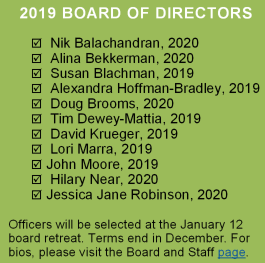
Congratulations to the five incumbents re-elected to the NCRA Board:
Nik Balachandran, Alina Bekkerman, Doug Brooms, Hilary Near and Jessica Jane Robinson.

Thirteen members were written in for the sixth open seat – perhaps a record! The current Board of Directors selected Lori Marra for the remaining spot. Thirty-three percent of the members voted; two abstained.

Thank you to the folks who cast write-in votes as well as those that were written in. We look forward to your continued involvement. The Communications Committee will be politely contacting you!

Appreciations to the Election Committee –  Portia Sinnott and Steve Sherman, and Juliana Gerber, NCRA Administrative Coordinator, for managing the nominations.

Officers will be selected at the January 12 board retreat. Terms end in December. Click here for Candidate Statements. For bios, please visit the Board and Staff page.


# # #


ZFWF: Federal Interest In Edible Food Waste Recovery, 10/18

Over 100 public sector, nonprofit and private sector professionals turned out for a program focused on successful statewide and regional policies and programs in food waste prevention and reduction and edible food re-purposing and recovery. The working forum provided opportunities throughout the day for attendees to break into smaller groups and delve more deeply into these subjects with presenters and colleagues.

NCRA hosted this second Zero Food Waste Forum on World Food Day – October 16, 2018, in Berkeley, in conjunction with the Solid Waste Association of North America (SWANA) Gold Rush Chapter and with support from the UC Berkeley Basic Needs Committee, Food, Equity, Entrepreneurship and Development (FEED), and the Ugly Fruit & Veg Campaign.

The purpose of the Forum was to provide an opportunity for local jurisdictions to better understand the direction and intentions of Senate Bill 1383 (2016), which requires that no less than 20 percent of edible food currently disposed of in California be recovered for human consumption by 2025.

Attendees enjoy food catered by FoodShift, a local non-profit that offers culinary job training, uses rescued food as a primary resource and sells and donates their products and coffee from 1951 Coffee, a non-profit specialty coffee organization providing job training and employment to refugees and asylmees. In the afternoon, Regrained offered attendees a snack of powerbars made from grains rescued from local breweries.

Setting the Stage
Martine Boswell of CalRecycle opened the day with an overview of SB1383’s requirements and notice of CalRecycle’s next round of Food Waste Prevention & Rescue Grants for which $5.7 million is allocated. NCRA will keep you posted regarding the grant cycle.

Justin Malan with Ecoconsult described the important work happening state-wide with environmental health inspectors, as AB1219 and related legislation now require them to inform food service businesses, about their right to donate food without fear of liability and about food donation options.

Melissa Romero of Californians Against Waste, gave an update on recent Food Waste Prevention, Recovery and Reuse Legislation and Regulations, including AB 954 (Chiu), the Uniform Food Date Labels bill which promotes the adoption of uniform date label phrasing to reduce consumer confusion, and SB 557 (Hernandez), which allows schools to donate food items that have been served and placed on share tables to food banks. Romero also reviewed the implementation deadlines of AB1826 which requires local jurisdictions across the state to implement an organic waste recycling program.

Innovative Programs
Barbara Hamilton, San Diego Food System Alliance, led off by describing a strategic county-wide food waste awareness partnership that leverages the national “Save The Food” public service campaign (a partnership with NRDC and the Ad Council) for community education, Re-Plate technology for food recovery, and LeanPath for food waste prevention. SDFSA is happy to share their material and strategies with other local jurisdictions.

Iesha Siler and Alyson Schill with the LA Food Policy Council, shared lessons learned from Los Angeles’ innovative public-private partnerships to promote food rescue. They described RecyLA’s new waste hauler contracts, requiring that haulers dedicate funding for the redistribution of edible food “before the bin,” in partnership with local non-profits. They also described some innovative approaches the City has taken to promote food waste prevention and organics recycling, including establishing composting hubs.

Robin Martin with Silicon Valley Food Rescue described the newly-launched pilot A La Carte program, which encompasses fleet of food trucks to rescue surplus food from institutions and deliver it directly to those in need, removing the intermediate steps of storage and redistribution. The pilot currently has one truck collecting food from Stanford University and delivering it to locations in Mountain View, Sunnyvale, East Palo Alto, and Palo Alto.

Annalisa Belliss with StopWaste presented an overview of the StopWaste Smart Kitchen Initiative, providing free access to LeanPath equipment and software for a year to large food service providers, caterers and commercial kitchens, to support their efforts to reduce pre-consumer food waste and identify donation opportunties. StopWaste has also launched a Smart Cafeteria Initiative, offering resources to staff and students in school districts throughout the state to prevent food waste and support food recovery and reuse.

Innovative Measurement Tools
Darby Hoover of the Natural Resources Defense Council (NRDC), described the challenges of measuring household food waste and the progress NRDC has made collecting food waste data in Nashville, Denver and New York City through kitchen diaries, bin digs and surveys. They found that 68% of discarded residential food was potentially edible. Based on their research, NRDC recommends that cities conduct city-wide baseline food waste and food rescue assessments in order to most effectively leverage city resources and tailor residential education programs.

Wendi Shafir, LEED, AP Sustainability, shared 3 ways to measure food waste for commercial generators, the pros and cons of each, resources about each, and how to use the data to inform policies and programs. The measurement options include wasted food sorts, wasted food audits, and wasted food tracking.

Nate Clark with Spoiler Alert explained how large food service businesses can use operational Key Performance Indicators (KPIs) and data-driven approaches to reduce food waste. KPIs include: Shrink Rate (product that a company doesn’t sell despite best wishes and intentions), Diversion Rate (product that is diverted from the landfill to a higher and better use) and Recovery Rate (product recovered for human consumption). By monitoring this data and the causes, a business can develop strategies to improve profitability.

Steven Finn of LeanPath described LeanPath’s automated waste prevention technology designed to measure food waste and help drive behavior change among commercial generators. After all, “you can’t manage what you don’t measure” – Drucker.

# # #

NRC 2018 Awards

The National Recycling Coalition 2018 Awards Recipients, 10/15/18

Yesterday, The National Recycling Coalition (NRC) honored their recycling awards recipients at the 2018 Resource Recycling Conference in St. Louis.  The awards were presented to the winners, along with the recipients of the Murray J. Fox Scholarship, at a special ceremony.  The awards were especially meaningful on the 40th anniversary of the founding of NRC.

The awards program is designed to honor and recognize outstanding individuals, programs, and organizations around the country, both for their achievements, and to serve as a model and a resource for learning for NRC members.  Award categories recognize outstanding programs in for-profit businesses, higher education, non-profit organizations, and community / governmental programs, as well as awards for outstanding emerging leader and lifetime achievement.  The NRC will be posting information on all winners on the NRC’s website.

NRC’s Awards Committee Chair Lisa Skumatz commented on the process saying of fellow committee members, “They worked long and hard to sort from among the huge number of submittals to find those shining examples – a task that was made particularly hard because there were so many really stellar nominees.”  She noted that “The winners embodied best practices, and we were very pleased that winners came from across the country to accept their awards, so attendees had the chance to learn first-hand how these programs work so well!”

Jack DeBell, Chair of the Murray J. Fox Scholarship program presented three St. Louis-area university students with scholarships to assist in their education.

2018 Awards

  • Lifetime Achievement in Recycling – Gary Liss
  • Bill Heenan Emerging Leader – Leana Houser, Johns Hopkins University
  • Outstanding Community / Government Program – County of Santa Cruz
  • Outstanding Business Leadership-For Profit Company – Cox Enterprises , Atlanta
  • Outstanding Not-for-Profit Business Leadership -Bridging the Gap, Kansas City, MO
  • Outstanding Recycling Organization – Colorado Association for Recycling (CAFR) / Recycle Colorado
  • Outstanding Higher Education Winner – University of Wisconsin-Stevens Point

On hand to help present the awards were NRC’s Chair, Lisa Skumatz (of Skumatz Economic Research Associates); NRC’s President David Keeling (of the Steel Recycling Institute); and Marjorie Griek, NRC’s Executive Director.

Details of the Awards and Winners

Outstanding Business Leadership For-Profit Company: Cox Enterprises
Cox Enterprises believes working towards positive environmental change is important — both inside the company and in the communities they serve. This underlying principle influences their business operations and investments, acting as the catalyst for establishing their environmental sustainability division, Cox Conserves, in 2007. In 2013, Cox Conserves adopted three aggressive goals: carbon and water neutrality by 2044, and zero waste to landfill (ZWTL) by 2024 (diverting 90% of waste from landfill and incineration).

Cox has intensively focused on achieving ZWTL and developed purposeful programs aimed at properly managing their waste streams. Five years later, this call to action for ZWTL goes out to their companies across the US and entreats their employees to embrace environmental stewardship, enabling them to lead by example in this journey towards sustainability. These challenging goals demonstrate the organization’s commitment to being thoughtful stewards of the environment, while searching for innovative ways to grow the business responsibly.

Outstanding Not-for-profit Business Leadership: Bridging the Gap
Bridging The Gap (BTG) is a Kansas City based not-for-profit dedicated to environmental education and action through volunteer engagement. Bridging The Gap was founded in 1992 by attorney Robert J. Mann whose vision of community building across government, business and the private sectors soon translated into environmental activism.

BTG established the city’s first drop-off recycling center, helped establish many regional recycling centers, advocated for curbside recycling in KCMO, and eventually coordinated community education for the long-awaited curbside program when it was finally adopted, thirteen years later. Today, BTG is the home of many diverse environmental programs, including the Business Recycling Program which has helped over 130 businesses achieve waste reduction and implement recycling programs over the past five years.

Outstanding Recycling Organization: Colorado Association for Recycling / Recycle Colorado
Over the last few years, CAFR faced many of the same challenges other ROs were facing:  mergers that reduced membership, programs suffering from lower market prices, contamination, and market challenges; and the complexities associated with very low landfill prices, a significant rural component, and weak state-level authorities.  Rather than suffer a slow decline, CAFR shook things up, hiring a new ED, updating its vision / mission / operations plan, and adopting a mantra of undertaking only activities that were tangible, actionable, and measurable, and focusing on infrastructure, end markets, and policy.  Member services were no longer the focus.  They shook up the traditional model in membership, conference session design, councils, partnered with non-industry NGOs, solicited sponsors for targeted projects, and in one year increased membership 50%, and significantly exceeded sponsorship and revenue goals.  To signal the change, they changed their name.  This RO has ideas that can be learned from! 

Outstanding Higher Education: University of Wisconsin – Stevens Point
The University of Wisconsin – Stevens Point has been running an exemplary recycling program since it was designated as a Solid Waste Experiment Center in 1990. Annually, over 500 tons of landfill waste is avoided and $17,000 saved on average in avoided landfill tipping fees.

The university’s Waste Education Center (WEC) is an extraordinary facility that functions as a materials recycling and composting facility, provides training in sustainable waste management practices and is used for research trials. WEC is administered by the College of Natural Resources (CNR). The CNR offers an undergraduate degree in Soil and Waste Resources with a Waste Management option to prepare students for jobs at landfills, wastewater treatment facilities, hazardous waste sites, recycling and composting centers. Students utilize the WEC as a classroom and lab, and perform research activities as well. Waste management graduates enjoy placement rates of 90-100% and work at private companies and government agencies.

Outstanding Community or Government Program: Santa Cruz County CA
Santa Cruz County has been a leader in recycling and waste reduction for decades. The source of many innovative programs from bans on plastic bags and Styrofoam to EPR programs for drugs and sharps, requirements for sustainable practices in food service businesses, composting of food waste, creative source reduction efforts, outstanding outreach and education programs and more, Santa Cruz County has won numerous awards and accolades from industry organizations, environmental groups and elected officials. They continue to model best practices for other programs around the country and to constantly strive toward greater sustainability and zero waste.

Bill Heenan Emerging Leader: Leana Houser
Leana Houser has dedicated herself to initiating and improving programs that ensure environmental and social responsibility are embedded in JHU operations, and shows the same commitment in her personal life – oftentimes bridging the two to blur lines and amplify impact. She helped found the regional network B’CaUSE (Baltimore Colleges and Universities for a Sustainable Environment), has served on the board for Friends of Patterson Park, and as been a mentor to numerous interns and employees at Hopkins.

Her charisma, creativity and compassion make her a valued leader adeptly able to bring different partners and stakeholders together to find common ground for the greater good.   From connecting her daily work to divert furniture and provide waste bin infrastructure – the diversion of which improves public health across the city by avoiding the incinerator – to connecting the work of those city nonprofits by way of furniture and bin donations, Leana leads by example.

Lifetime Achievement in Recycling – Gary Liss
Mr. Gary Liss has over 40 years of experience in the solid waste and recycling field.  He was a founder and past President of the National Recycling Coalition and was Solid Waste Manager for the City of San Jose, CA.  In San Jose, Mr. Liss developed their recycling programs into national models, which are currently diverting 62% of the overall waste stream.  In addition, Mr. Liss is a leading advocate of Zero Waste, and a special Zero Waste advisor to the GrassRoots Recycling Network (GRRN). Gary Liss’s litany of achievements started in 1970 helping start students organized against pollution (SOAP) at Tufts, continued through MassPirg, appointments with Sierra Club of New Jersey, Engineering Department in Newark, NJ, NJ State Department of Energy working on Alternate Technologies to focus on Recycling, and closed out the 1970s by writing part of NJ’s energy master plan setting a statewide goal of 25% recycling, worked with the Institute for Self Reliance, US Conference of Mayors, and serving as the Sierra Club representative to join the first Board of the NRC / and was elected chair in 1978.  And those are just his efforts in the 1970s.

In the 1980s, he moved to California and started moving things forward there.  He worked on waste issues in San Jose, continued on the Board of the NRC, and worked on waste reduction strategies at the municipal level.

In the 1990s, and specifically in 1995, he helped develop the Grass Roots Recycling network to champion Zero Waste, started Gary Liss & Associates, and began the work he continues to this day – working with the NRC, and helping communities across North America and internationally on Zero Waste.  His current titles include: President Gary Liss & Associates, a Founding Board Member and Past President of NRC; VP of Zero Waste USA; Board member Zero Waste International Alliance, and Past President US Zero Waste Business Council.

Gary is tireless, dogged, determined, and committed – and now his is also an award winner.

The National Recycling Coalition congratulates all of this year’s winners!

Notable sponsors and contributors of these awards include: SCS Engineers, Institute of Scrap Recycling Industries, Robert Gedert, Container Recycling Institute, Waste Management, Skumatz Economic Research Associates / SERA, George Dreckmann, Barbara Eckstrom, Fran McPoland, Susie Gordon, Melisssa Young, MaryEllen Etienne, Marjie Griek, NRC Executive Director, Mark Lichtenstein, NRC Board, Leslie Lukacs, Steel Recycling Institute, The Recycling Partnership, Dylan DeThomas.
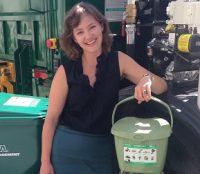
Member Interview – Hilary Near, 12/18

HILARY NEAR, NCRA MEMBER SINCE 2009
As Commercial Zero Waste Analyst for San Francisco Environment, I serve the City and its goals of living more lightly on our Earth through designing and participating in Zero Waste systems. Working primarily with businesses to improve their recovery programs, I consider myself an ambassador for behavior change necessitated by mandates and environmental initiatives.

My formal education includes a BA from UC Berkeley and MPA from San Francisco State. One of the first times I felt like I was among “my people” and chosen path was in StopWaste’s Master Composter class of 2007. Since then, I’ve had the immense privilege of working for some of the Bay Area’s most generous and progressive organizations/people – StopWaste, Cascadia Consulting Group, City of Oakland and San Francisco Department of the Environment. I continue learning on the job and through extra courses like NCRA’s Introduction to Recycling (2009) and US Composting Council’s Compost Operator Training Course (2014). I joined the NCRA Board in 2017. One reason I show up daily to work toward Zero Waste is the chance to continually learn and share with so many passionate change makers!

I’m grateful to enjoy my work for San Francisco Zero Waste. I feel refreshed in my free time by connecting with the soil and other creatures. I care for a small plot in the Oakland Golden Gate Community Garden and several bee hives, along with a cat with whom I share a small studio at North Oakland Golden Gate Co-Housing. Tis the season for wild mushroom foraging, and I love to hike the East Bay hills and head home with a delicious haul of local chanterelles and other fruits of the forest. My yoga and meditation practice are essential to ground and inspire me on this life journey. Come join me for a yoga class at Barefoot Movement in Uptown Oakland!

I’m also inspired by the commitment and love that my co-housing community demonstrates as they show up for each other at weekly meals, hard conversations and little neighborly actions.

Vacation dreams? I would go on another, longer bike packing trip. In Fall I set off on the train to Eugene, Oregon and biked home, camping along the way and going at my own pace. I loved it! I’d continue the trip down the Pacific Coast all the way to Chile, even!

# # #


What Does Brett Kavanaugh Have To Do With Zero Waste?

WHAT DOES BRETT KAVANAUGH HAVE TO DO WITH ZERO WASTE?
In case you have not read or heard enough about Brett Kavanagh
By John D. Moore, NCRA Vice President and Legal Counsel

Before being nominated to the Supreme Court, Brett Kavanagh was a judge of the US Court of Appeals for the DC Circuit. This Court frequently is asked to decide issues involving federal agencies, like EPA. EPA has extensive rules and regulations defining what is “recycling” or “recyclable” as distinct from solid waste. Hazardous waste is simply a subset of solid waste. EPA’s definitions have been used by other Courts in a variety of circumstances. Trust me that these regulations are difficult to follow with exceptions, exceptions to the exceptions, and tables purporting to summarize all these rules that are found in at least 10 places. On the other hand, “Solid waste” has never been defined by the Supreme Court notwithstanding that the Court has long declared solid waste to be an article of commerce for purposes of applying the Commerce Clause of the Constitution to local government actions involving flow control. Since Judge Kavanagh may have opportunity to shape the definitions of recycling and solid was a member of the Supreme Court, it is worth looking at Court decisions he has participated in which EPA’s definitions were challenged. EPA’s remit under the federal Resource Conservation and Recovery Act (RCRA) is to regulate landfill standards and to regulate disposal of hazardous waste. When a collector wants to salvage recyclable material from a hazardous item of waste, such as a foundry sand containing lead, this intersects with EPA’s regulatory oversight. For this purpose EPA has tried to distinguish and define “sham recycling.”

A lot of EPA’s rules were challenged by Industry Groups and the Sierra Club. Judge Kavanagh concurred in the majority (2-1) opinion. It really isn’t possible to summarize this case with any brevity since there were several discreet issues in interpreting interlocking regulations with extensive legislative and regulatory history found in the Federal Register. This cannot be quickly outlined. But there were two aspects of this opinion, API v. EPA 862 F.3d 50 (DC Cir 2017), that I thought reflected on Judge Kavanagh’s suitability to serve on the Supreme Court. One, the majority was able to comprehend an enormous regulatory scheme; and 2) the opinion reflects an understanding that RCRA and EPA regulations are not aimed at “materials that otherwise would become solid waste.”

This first impression relates to “qualification” to serve on the Supreme Court. As we have seen, these “qualifications” are not defined or even commonly understood, let alone uniformly applied. It’s a little like voting for the MVP in professional sport; it’s in the eye of the beholder and reflects the values of the beholder. I have observed in law practice a similar definitional problem. In child custody disputes, the overriding concern is the “best interests of the child.” And who could argue with that? But divorcing parents often have dissimilar views of what this means and their view is often colored by their perception of the other contestant for custody. In a no-fault divorce state like California there is no forum for a divorcing spouse to say why the other spouse is so bad. So that need for emotional outlet gets transferred unfortunately onto a fight over what is best for the child; with ugly results. You could make a good case that the framers of the Constitution intended that the selection of a Supreme Court justice with the “advise and consent of the Senate” be a political process and that the political party with the majority power got to use its own interpretation of qualifications for the office. And if the Senate majority decides that a past sexual assault and lying to the Senate were not disqualifiers, the framers would say “so be it”.

If one likes Judge Kavanagh’s views about distinguishing solid waste from recyclable and that “like” satisfies the “qualification” requirement, this is using a political view to make a political decision. And just like tribal societies in Central Asia, history is a cycle of those who are in and those who are out and where those that are in take what they want without regard to the overall health of the nation. I am sure that the framers did not intend this to happen. Many writers have opined how our country got to this state but few propose a solution to return to democracy and polite discourse in favor of the best interests of the country. When our leaders behave like spoiled children they are not acting in the best interests of the country.

Politics works in different and strange ways. Most blue state voters would agree that Earl Warren was among our greatest Supreme Court justices. But his appointment, having a very California flavor, was as political as any. There were 3 prominent Republican politicians who coveted the Presidency in the early 1950s. One was Warren, a popular 3 term Governor of California (and former Alameda County District Attorney who sought the death penalty), Senator William Knowland of Oakland (and owner of the Tribune then) who was the Senate Majority leader (the Mitch McConnell position) and Vice-President Richard Nixon of Whittier. The popular version of this story is that Knowland and Nixon went to President Eisenhower and asked that Warren be made Chief Justice to get him out of California politics. Many Republicans came to regret that choice and campaigned in the 1960s to have Warren impeached. Through this terribly political process came the one Justice with the skill to insist that Brown v. Board of Education end racial segregation and that the Court so rule unanimously to preempt any question of its legitimacy. Another Justice on that Court was Hugo Black of Mississippi who was a member of the Ku Klux Klan at the same age that Judge Kavanagh was throwing down brewskis. If either Warren or Black’s confirmation hearing resulted in them yelling about Democratic party conspiracies, I am not aware of it and seems unlikely given their temperament.

It’s a scary time. Foreign countries may be influencing our elections by subterfuge, questioning what information and which news broadcaster can you trust. Or maybe they haven’t been and that is part of the subterfuge. And who has the skill to figure that out? This country has weathered many crises. It should have the resilience to withstand Donald Trump and Brett Kavanagh. But maybe Kavanagh will surprise like Earl Warren did. You may not want to see either politics or sausage being made but you can hope the output is palatable.


# # #