Why Isn’t Everyone Composting Yet? Part 2 – Uneven Access

By Tim Dewey-Mattia, Public Education Manager, Napa Recycling & Waste Services and NCRA Board Member, 4/1/21

Part 2: Uneven Access      (Part 1)       (Part 2)      (Part 3)

Former NCRA President Arthur R Boone recently posed a question to me via email on “Why the conversion of the yard debris green cart into the full-service organics cart has stumbled badly in getting rolled out? Would love to understand all that resistance better.” Here were my thoughts, which we both thought would be valuable to share with the rest of the NCRA News readers.


In Part 1 of this series, we talked about behavior change. For Part 2, we’ll discuss issues with uneven access to organics collection programs.

Organics program coverage is still not universal. While most single-family residential customers in the Bay Area may have access, a lot of multi-family and commercial still do not. It’s not ideal to have a situation where you compost the organics at home but have to throw it in the trash at work (or the other way around). There is a processing infrastructure issue here (fortunately not for us in Napa, but for other communities) – since the development of full-spectrum organics facilities is still lagging the pace it needs to keep.

These disparities in access mean this is an equity issue as well. Organics diversion will never be successful without full investment in access, education and ongoing support to all communities, and specific focus and resources need to go particularly to disadvantaged communities that have historically not been the focus of enough of waste diversion efforts.

It takes longer than we’d all like to onboard new organics customers, since they have to be trained to get organics out of the trash and into the compost containers. Napa has found that if you want a business to do it right and keep doing it, it takes a 6-week training process – which is hard to keep up and would require way more staffing than most communities have.

I think there is a $$ thing here – if you try and do it on the cheap, your program isn’t very successful. A massive investment in organics diversion, particularly for infrastructure but also for inclusive outreach – through increasing the state landfill tip fee, additional cap and trade money, green infrastructure funding, the Recology ballot initiative, whatever it is – would be very much appreciated.

Questions or comments? As always feel free to contact me at tim@naparecycling.com… or follow up with a Letter to the Editor or article of your own in the NCRA News!

# # #
Edible Food Recovery Technical Council, 4/21

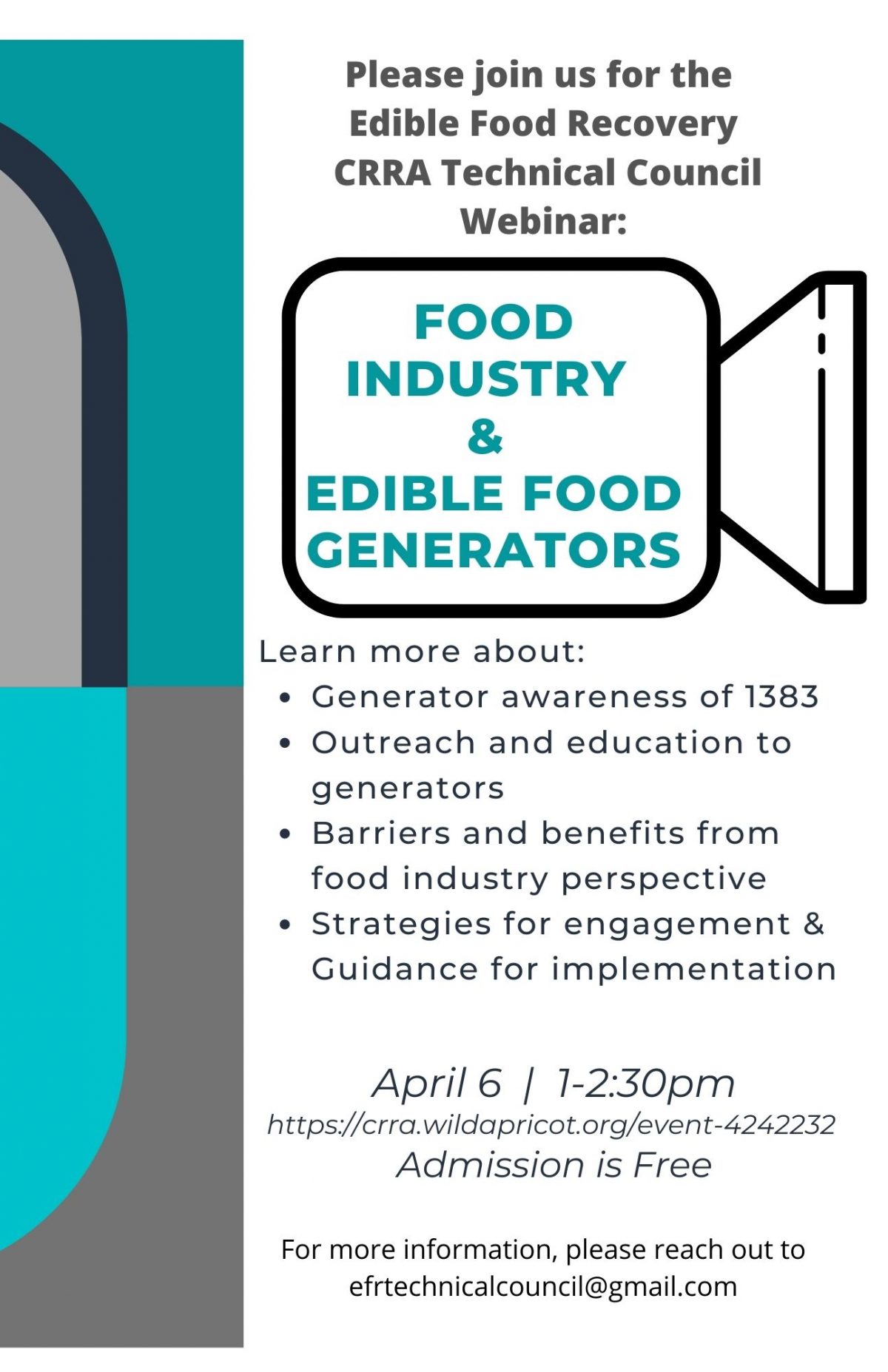
Join the CRRA Edible Food Recovery Technical Council for their upcoming webinar about the Food Industry and Edible Food Generators. Join in on Tuesday, April 6 from 1 pm – 2:30 pm for an afternoon webinar and learn more about:

  • Generator awareness of 1383
  • Outreach and education to generators
  • Barriers and benefits from the food industry perspective
  • Strategies for engagement & guidance for implementation

Register here: https://crra.wildapricot.org/event-4242232

Why Isn’t Everyone Composting Yet?  Part 1 – Behavior Change

By Tim Dewey-Mattia, Public Education Manager, Napa Recycling & Waste Services and NCRA Board Member, 4/1/21

Part 1 – Behavior Change       (Part 1)       (Part 2)      (Part 3)  

Former NCRA President Arthur R Boone recently posed a question to me via email on “Why the conversion of the yard debris green cart into the full-service organics cart has stumbled badly in getting rolled out? Would love to understand all that resistance better.” Here were my thoughts, which we both thought would be valuable to share with the rest of the NCRA News readers.

It’s true, the roll out of full-service organics across the Bay Area hasn’t been as successful as we all hoped. It’s tough to get a good read on participation levels, but I think from lid flips, load checks, customer surveys and anecdotal evidence, most Bay Area full-spectrum organics programs still see no more than 50% participation in the food scrap/soiled paper portion (as opposed to just using the cart for yard trimmings). The idea of the trash being the catch-all bin for throwing away everything is still strong and the default for many… and flipping that paradigm has proven to be tricky.

However, I do think there is still some optimism to be warranted – after all, curbside recycling had a multiple decade head start on curbside composting, and it took a while for recycling to become a commonplace activity for many people (of course, we know there are serious issues with curbside recycling, but at least we see the vast majority of customers participating – perhaps incorrectly – in the program).  One thing that composting has over recycling is that it’s less complicated with fewer rules of what can and can’t go in the cart, so over time we’ll hopefully see it become more successful.

For the first article of this series, I’ll focus on behavior change.

I think we badly underestimated the “Ick Factor.” We told customers that it’s the same stuff they were throwing in the trash and that it just needs to go in that different bin next to your sink. But, of course, they use a trash bag for trash, and without a bag the kitchen bin got gross, smelled bad abd attracted fruit flies, etc.  So, customers immediately gave up.

I do think that a solution to this is more widespread usage of compostable liners in the kitchen pails – obviously some people are fine with cleaning the bin frequently, using old newspaper as a liner or freezing their food scraps, but for a lot of the public it needs to be an easy solution like the bag.  The compostable bags are available at a lot of stores now (and in Napa we now provide samples to customers along with their Sure-Close pail), but I think that a potential option here (which I’ve seen as fairly commonplace in Italy, among other places) is to have grocery store produce bags be mandated to be compostable, and then they could be used to collect kitchen food scraps.

We also are dealing with the issue of customers just shoving most of their food scraps down their sink disposals.  The wastewater treatment folks don’t want this to happen, but it’s still commonplace – so we continue to work on outreach to get customers to get the food out of the sink and into the pail.  Also, often customers have an idea of what can go in a backyard compost pile, but don’t grasp that the full-spectrum curbside programs also take meat, bones, pet food, and all soiled paper products.

While many communities have delivered the food pails (Sure-Close, or other options) and conducted ongoing outreach campaigns, I realize that the program roll out was still fairly passive. After all, for most programs in our region, it wasn’t even necessary to deliver a new cart – it was just “throw it all in your yardwaste cart… which isn’t just a yardwaste cart anymore” or whatever. While we may have slapped a new sticker on the cart lid – or ordered new carts with inmolds showing all the stuff that can go in the compost cart – there are a lot of carts out in the field that still don’t have proper labeling…or the labeling just isn’t compelling enough to drive behavioral change. With SB 1383 roll out, we all have the opportunity be more active in our outreach campaigns going forward.

Questions or comments? As always feel free to contact me at tim@naparecycling.com… or follow up with a Letter to the Editor or article of your own in the NCRA News!