Northern California Recycling Association – Virtual Board Meeting – Thursday, July 16, 2020, 6-9 pm
6-6:30 pm Informal Sharing, 6:30-9 Meeting
Contact NCRA to receive the Zoom Link
Northern California Recycling Association – Virtual Board Meeting – Thursday, July 16, 2020, 6-9 pm
6-6:30 pm Informal Sharing, 6:30-9 Meeting
Contact NCRA to receive the Zoom Link
By David Krueger, NCRA President, 7/13/20
Editor’s Note: This is an update of the June 9 article – Loving Reusables in the Time of COVID, in which NCRA recommended counties be encouraged to revise their SIP Orders to allow reusables with some restrictions, provided the customers and the store follow Cal-OSHA guidelines (pdf),
On March 16, 2020 Alameda, Contra Costa, Marin, Santa Clara, Santa Cruz, and San Mateo Counties, plus the City and County of San Francisco and the City of Berkeley issued identical Shelter-in-Place Orders. (APNews, 3/16/20) On March 31, these jurisdictions issued identical updated Orders which banned reusables in retail establishments. These Orders all contained the same language on reusables, found in Appendix A of each Order: Social Distancing Protocol, Measures to Prevent Unnecessary Contact, which is a checklist for businesses to follow and directed to post:
Not permitting customers to bring their own bags, mugs, or other reusable items from home.
This language was then adopted by other jurisdictions including Napa and Sonoma Counties.
In response, on June 10 NCRA emailed custom letters to more 10 Northern California health officials, asking them to change their Orders to allow reusables again. and encouraging them to use the language from the Mendocino County Order:
Not permitting customers to bring their own bags, mugs, or other reusable items from home that must be handled by employees. Customers bringing their own reusable items that do not require handling by employees is permissible.
To date, Alameda County and Contra Costa County have adopted the Mendocino language allowing reusables, as requested by NCRA.
The City of Berkeley’s Order (which supersedes Alameda County’s) states that “Customers are permitted to bring their own bags, mugs, or other reusable items from home, but they must not place them on any surfaces” making it difficult to use the items as “surfaces” includes shopping carts.
Santa Clara County’s Order stills says “Do not allow customers to use their own cups or other reusable food containers from home for takeaway”, but allows customers to use their own shopping bags as long as businesses “Require customers using reusable bags from home to bag their own groceries”. On July 1, Napa County adopted the Santa Clara language regarding reusable bags in response to letters from NCRA.
The City and County of San Francisco has stated that they will be revising their Order on July 13 to allow reusable bags “… provided customers follow specified measures to bag their own items and ensure reusable bags do not touch employees or check-out conveyors”. Santa Cruz County’s Health Officer, Dr. Gail Newel, responded to the NCRA letter that “I am fully supportive and nothing in our local orders or guidance prohibits such practices.”
# # #
ZERO WASTE DECLARATION
Zero Waste International Alliance, 2020
The first Earth Day was 50 years ago. Recycling, its natural industrial child, was envisioned to complete the resource circle, save the wilderness, generate jobs, and build the back end of the GNP all at once.
Now, in 2020, we are ready to establish a collective goal of:
“Zero Waste: the conservation of all resources by means of responsible production, consumption, reuse, and recovery of products, packaging, and materials without burning and with no discharges to land, water, or air that threaten the environment or human health.” ZWIA, updated 2018
This Zero Waste World can be founded on environmental and social justice principles that help create vibrant communities in harmony with nature:
Redesign: Manufacturers can redesign products for highest and best use focusing in on reuse, repair and composting with recycling as a final option.
Ban Wasteful Products: We can ban products that require wasting to compel redesign for durability, repair, composting and recycling.
Source Separation: We could collect all discarded materials and products separated at the source and further sort them into higher quality fractions for reuse, recycling, or composting, with nothing left out and nothing left over.
Resource Recovery Parks: We can build a new worldwide network of resource recovery parks to handle all discards as refined resources.
Advocate: Use our power as advocates and professionals to show what is possible and help policymakers avoid mistakes in meeting the goals that we help them envision.
To achieve a worldwide culture that sustains the planet in perpetuity we stand together!
To sign-on to this declaration, please …
By David Krueger, NCRA President, 6/9/20
Editors note: Most, but not all of these links are downloadable pdfs.
There has been a lot of confusion lately about whether or not stores and restaurants are allowed to let customers bring their own shopping bags, mugs, or other reusable items. While the State does not prohibit reusables, local jurisdictions are allowed to have COVID-19 regulations that are stricter than the State’s. (Packaging Law, 4/22/20)
On March 16, 2020 Alameda, Contra Costa, Marin, Santa Clara, Santa Cruz, and San Mateo Counties, plus the City and County of San Francisco and the City of Berkeley issued identical Shelter-in-Place Orders. (APNews, 3/16/20) These Orders all contained the same language on reusables, found in Appendix A: Social Distancing Protocol, Measures to Prevent Unnecessary Contact, which is a checklist for businesses to follow. The specific language was: __ Not permitting customers to bring their own bags, mugs, or other reusable items from home.
Relaxed Restrictions
The Shelter-In-Place Orders have been changing rapidly since March, and the Bay Area jurisdictions listed above no longer have identical Orders.
Alameda County, (Page 6) and the City of Berkeley, (Page 7) now state: “Customers are permitted to bring their own bags, mugs, or other reusable items from home, but they must not place them on any surfaces.” Stopwaste is seeking clarification from Alameda County and the City of Berkeley regarding the definition of “surfaces” before educating the public about this new Order.
Santa Clara County (Page 4) still says “Do not allow customers to use their own cups or other reusable food containers from home for takeaway”, but allows customers to use their own shopping bags as long as businesses “Require customers using reusable bags from home to bag their own groceries”.
Still Prohibiting Reusables
Contra Costa County, (Page 2)
Marin County, (Page 6)
Napa County, (Page 2)
San Francisco, (Page 2)
San Mateo County, (Page 2)
Santa Cruz County, (Page 2)
Solano County – TBD
Sonoma County, (Page 3)
NCRA Recommendations and Suggested Actions
NCRA and Californians Against Waste recommend using Mendocino County’s (Attachment A, Page 24) language regarding reusables: “Not permitting customers to bring their own bags, mugs, or other reusable items from home that must be handled by employees. Customers bringing their own reusable items that do not require handling by employees is permissible.”
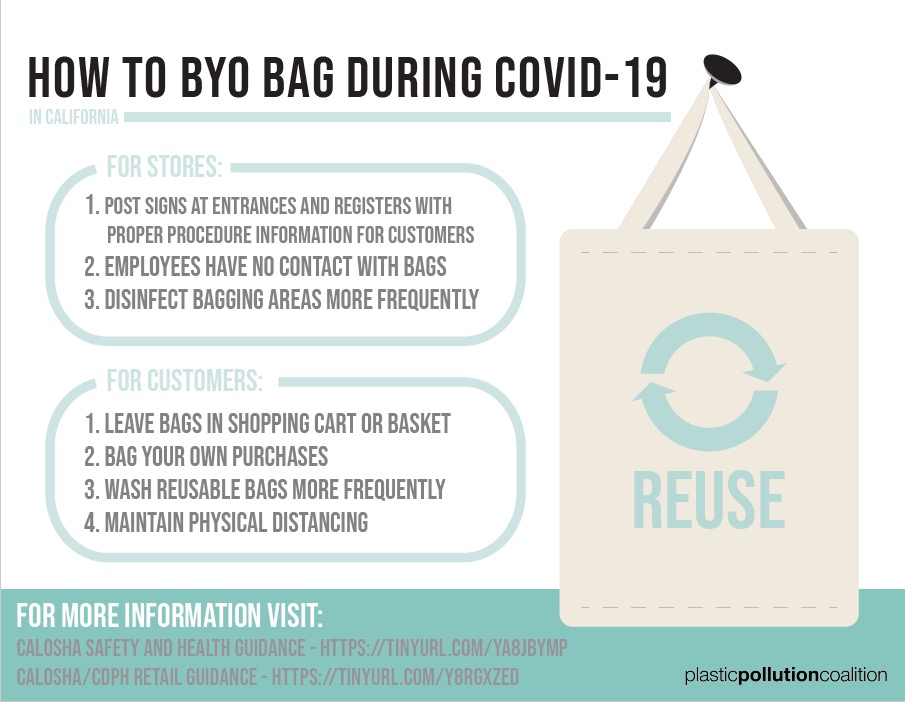
We also recommend that customers be allowed to bring their own reusable shopping bags as long as the customers and the store follow the Cal-OSHA guidelines for the safe use of reusable bags (pdf):
On April 21, 2020 NCRA sent letters to six of the prohibiting jurisdictions listed above encouraging them to allow reusables. On April 27, 2020, NCRA signed on to the attached letter organized by Upstream Solutions. On June 10, we sent eight letters encouraging the receiptant jurisdiction revise their order as per Mendocino County’s (Attachment A, Page 24) . (See each (NCRA LETTER) in Health Officer List below.
What Can You Do?
1. SHOP WITH REUSABLES
When reusables are “legal” again, shop at establishments that allow them and encourage others to follow. Note that some stores and restaurants may still choose to prohibit reusables even if they are not required to.
Here is bagging advice from Zero Waste Sonoma: However, you can still use reusable bags; just leave them in your vehicle, or if you don’t drive to the store, keep them in a backpack or handbag, and ask the bagger to place groceries directly into the cart at checkout. When you exit the store, transfer items from the cart into your bags. As an extra precaution, wash your bags between uses.
2. WRITE YOUR HEALTH OFFICER
Please write your local health officials to allow reusables again. Encourage them to adopt the Mendocino County Attachment A language. “Not permitting customers to bring their own bags, mugs, or other reusable items from home that must be handled by employees. Customers bringing their own reusable items that do not require handling by employees is permissible.” (See each (NCRA LETTER) in Health Officer List below.
Bay Area Health Officials and Sample Letters
Dr. Erica Pan, Interim Health Officer (NCRA LETTER)
Alameda County Public Health Department
1000 Broadway Suite 500, Oakland, CA 94607
510 267-3200, Erica.Pan@acgov.org
Lisa B. Hernandez, MD, MPH, Health Officer (NCRA LETTER)
City of Berkeley, Health Housing, and Community Services
1947 Center Street, 2nd Floor, Berkeley, CA 94704
510 981-5308, Fax: 510 981 5395, lihernandez@cityofberkeley.info
Christopher Farnitano, MD, Health Officer (NCRA LETTER)
Contra Costa County Health Services
50 Douglas Drive, Suite 310-A, Martinez, CA 94553
925 957-2679, Chris.Farnitano@hsd.cccounty.us
Matthew Willis, MD, KPH, Public Health Officer and Benita McLarin, Director (NCRA LETTER)
Marin County Health and Human Services
3240 Kerner Boulevard, San Rafael, CA 94903
415 473-4163, bmclarin@marincounty.org; mwillis@marincounty.org
Tomás J. Aragón, MD, DrPH, Health Officer (NCRA LETTER)
San Francisco City and County Department of Public Health
101 Grove Street, Room 308, San Francisco, CA 94102
415 554-2710, tomas.aragon@sfdph.org
Scott Morrow, MD, MPH, Health Officer and Cassius Lockett, Director (SAMPLE LETTER)
San Mateo County Public Health Department (NCRA LETTER)
225 37th Avenue, San Mateo, CA 94403
650 573-2519, smorrow@smcgov.org; clockett@smcgov.org
Sara H. Cody, MD, Health Officer (NCRA LETTER)
Santa Clara County Public Health Department
976 Lenzen Avenue, 2nd Floor, San Jose, CA 95126
408 792-3798, sara.cody@phd.sccgov.org
Gail Newel MD, Health Officer (NCRA LETTER)
County of Santa Cruz Health Services Agency
Post Office Box 962, 1080 Emeline Ave., Santa Cruz, CA 95061-0962
831 454-4000, Fax: 831 454-4488, gail.newel@santacruzcounty.us
Dr. Sundari Mase, Interim Health Officer (NCRA LETTER I/P)
Sonoma County Department of Health Services
1450 Neotomas Avenue, Suite 200
Santa Rosa, CA 95405
# # #
By Caren McNamara, Founder/CEO, 06/10/20
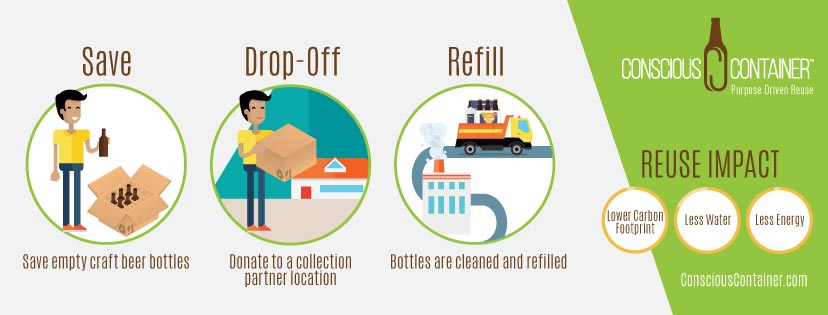
Refillable/Reusable/Returnable glass bottle systems can deliver an economically viable and environmental impactful solution to reduce single-use bottle packaging waste, as long demonstrated by refillable bottle systems all around the world.
Conscious Container was incorporated as a California Benefit Corporation – B Corp, in early 2017 to create a refillable glass bottle system here in the United States. Over the past 3 years Conscious Container has been conducting ‘proof of concept’ glass bottle collection pilots in Northern California and Northern Nevada. Pilots included an incentive-based drop-off program in Nevada, a donation-based drop-off program and a CRV redemption-based program in Northern California. Becoming a certified ‘Processor’ in the CalRecycle CRV system allowed Conscious Container to pilot with a recycler to separate specific CRV bottle for washing and refilling. These pilots provided insights on how a refillable system could operate while creating strategic partnerships with beverage producers, recyclers, waste haulers, non-profit organizations, policymakers and industry thought leaders.
In the later part of 2019 Conscious Container was asked to present our refillable program at several large industry events, including the Resource Recycling Conference in New Orleans and the Sustainable Packaging Coalition member event in Denver. From these events large beverage producers and retailers began to approach Conscious Container to learn more about our refillable business model, several of whom operate refillable/returnable bottle systems in other countries.
One company, Anheuser Busch InBev (ABInBev), encouraged Conscious Container to apply for their 100+ Sustainability Accelerator program. In early 2020 Conscious Container was one of seventeen start-up companies from around the world select to join the Accelerator program to conduct our business solution pilot in 2020. Although the pilot is a bit delayed due to COVID19 requirements, the partners intended to launch a refillable pilot in the San Francisco North Bay hopefully in Q3. Additionally, Conscious Container was honored with an invitation to join the Ellen MacArthur Foundation’s CE100 program which allows this innovative start-up a seat at the table to create circular economy solutions with large global producer Foundation members.
Conscious Container’s vision of ‘A World of Reuse Cultures & Economies’ stands out front. And, moving the needle on reducing our single use packaging waste, as many of you know, requires collaboration across many ecosystems. As Conscious Container’s Founder Caren McNamara often states, “Here we go…”.
Here is a short video about Conscious Container’s partnership with the ABInBev 100+ Sustainability Accelerator program.
# # #