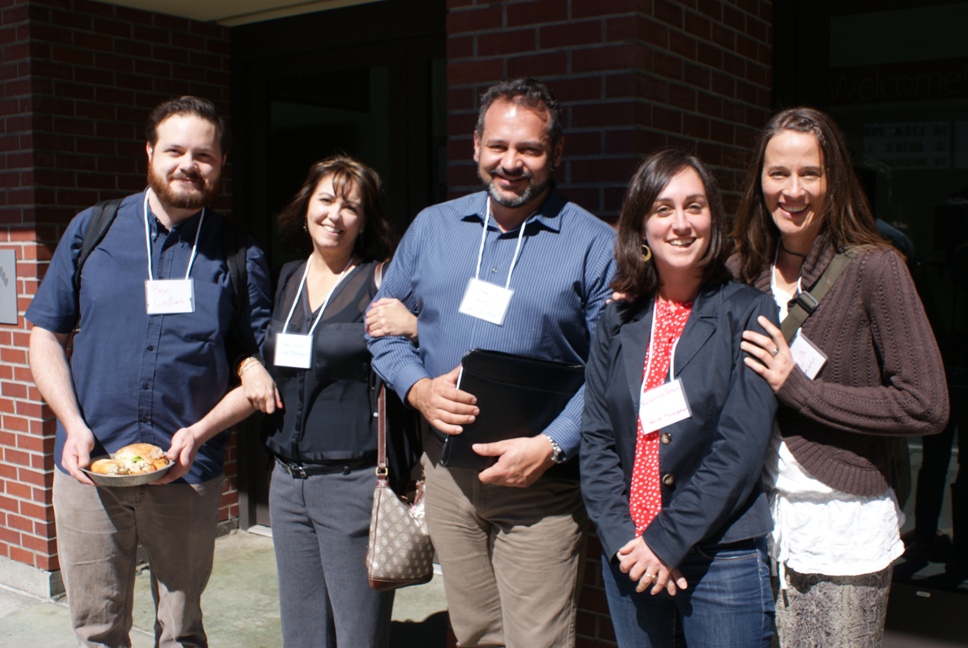
Zero Waste Week 2016 will be March 20 – 26. Our premier event, Recycling Update, will be held March 22 at Freight and Salvage in Berkeley. Note this is one week later than our usual date. Speakers include Jaren Blumenfeld, Dana Franz and Miguel Robles, Read More “Save-The-Date – Recycling Update and Zero Waste Week”
Author: Editor
Donate Food Without Fear of Being Sued
MOORE’S MUSINGS
A semi-monthly feature, exclusive to NCRA News, from NCRA general counsel and board member John Moore, concerning recent legal decisions relating in some manner to Zero Waste.
BE A GOOD SAMARITAN – DONATE FOOD WITHOUT FEAR OF BEING SUED
By John D. Moore, NCRA Vice President and Legal Counsel, Henn, Etzel & Moore, Inc.
Sometimes the fruit gets rotten
And falls on to the ground
There’s a hungry mouth for every peach
As I go ramblin’ ’round boys
As I go ramblin’ ’round — Woody Guthrie
Among the many reasons Woody Guthrie would have heard in the 1930s to justify not providing blemished peaches to the hungry – fear of getting sued was not likely among them, but he would not be surprised to learn that it is an excuse today. The purpose of this article is to present, unambiguously and emphatically, federal law which immunizes from suit everyone who donates food in good faith without actual knowledge that it is harmful. Please clip this article and show it to any prospective donor of food – grocery, caterer, restaurant, farmers market, who expresses reluctance to donate out of fear of being sued:
UNDER FEDERAL LAW (42 U.S.C. Section 1791(c)(1)), THE DONOR (person, entity, gleaner, nonprofit) OF FOOD IN GOOD FAITH IS NOT LIABLE FOR CLAIMS THAT THE FOOD CAUSED HARM.
This law is known as the Good Samaritan Law or more specifically the Bill Emerson Good Samaritan Food Donation Act. The story of the Good Samaritan is of course a nice story from the Bible. Jesus was being quizzed by a lawyer about what Jesus meant by “love thy neighbor”. Jesus described a man who had been attacked by bandits and left for dead on the road. Two priests passed him by without giving aid. A third, from Samaria, stopped, bound the man’s wounds, put him on his own donkey, took him to an inn and paid the innkeeper to look after him. The lawyer, shrewdly catching the drift of the story, said, “He that shewed mercy on him.” Then Jesus said, “Go, and do thou likewise.”
The drafters of the federal Good Samaritan law did not possess the simplicity of the biblical expression and so it has the ifs, ands and buts, common to statutes. In the interest of legal scholarship, I present the operative statutes. The primary statute, 42 U.S.C. Section 1791 (c)(1), says:
“A person or gleaner shall not be subject to civil or criminal liability arising from the nature, age, packaging, or condition of apparently wholesome food or an apparently fit grocery product that the person or gleaner donates in good faith to a nonprofit organization for ultimate distribution to needy individuals.”
Section 1791(c) (2) applies the same protection to nonprofits that receive donated food. Section 1791(b) defines all the terms used in the broadest fashion. For example, Section 1791(b)(4) defines “food” to mean, “ any raw, cooked, processed, or prepared edible substance, ice, beverage, or ingredient used or intended for use in whole or in part for human consumption.” Section 1791(b)(10) defines “person” broadly to include all types of business organizations, thereby covering grocery and produce stores, restaurants, farmers markets, and caterers.
While the statute does not define “good faith”, Section 1791(c)(3) states that the liability shield does not apply only where the donor is guilty of “ gross negligence or intentional misconduct.” Those two terms are defined by Section 1791(b) (7) and (8) to mean:
The term “gross negligence” means voluntary and conscious conduct (including a failure to act) by a person who, at the time of the conduct, knew that the conduct was likely to be harmful to the health or well-being of another person.
The term “intentional misconduct” means conduct by a person with knowledge (at the time of the conduct) that the conduct is harmful to the health or well-being of another person.
Finally, Section 1971(d) applies the same protections to the landowners where gleaning takes place, that is, the persons “who allow(s) the collection or gleaning of donations on (their property)”
California does not have an analogous statute. Since Congress has not stated an intent to be the pre-eminent legislative authority in this area, the state of California, or any local jurisdiction, is free to enact its own legislation expanding, but not reducing, the protections of the federal law.
After all that, if you are confused, please allow me to say it again in a declarative certain fashion:
UNDER FEDERAL LAW (42 U.S.C. Section 1791(c)(1)), THE DONOR (person, entity, gleaner, nonprofit) OF FOOD IN GOOD FAITH IS NOT LIABLE FOR CLAIMS THAT THE FOOD CAUSED HARM.
Help Steer NCRA Toward Zero Waste!
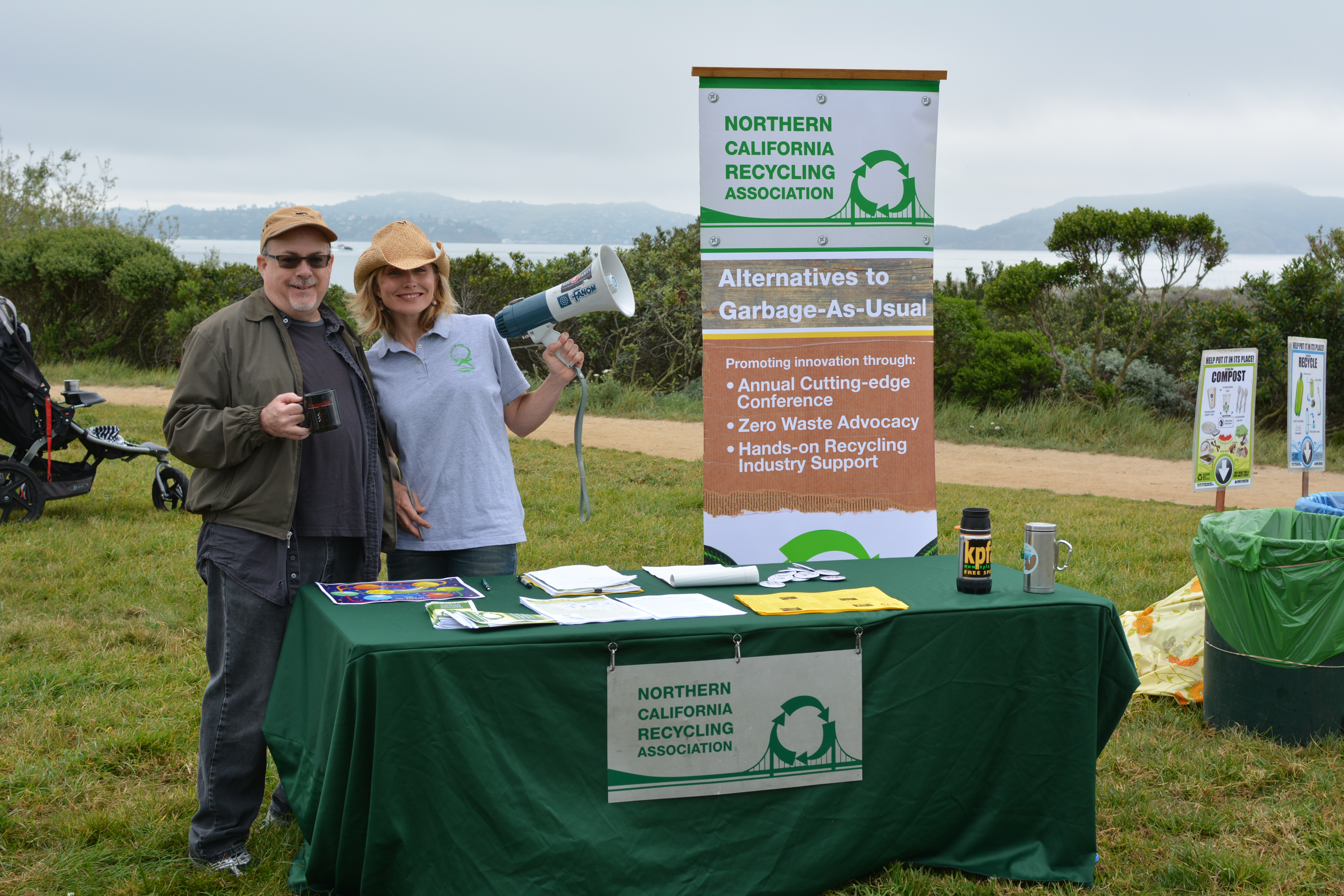
Serve On the NCRA Board!
Be at the heart of a thought-leading recycling organization! NCRA has been a leader in recycling thought since the 1980s and is still out front. You can help develop the cutting edge of recycling while you get to know many of the regional recycling who’s who by serving on the Board of Directors. Read More “Help Steer NCRA Toward Zero Waste!”
Boone Is Practicing HABU!
WHAT’S BOONE BEEN DOING? PRACTICING HABU!
By Arthur R. Boone, Center For Recycling Research and Total Recycling Associates
As NCRA’s longest-serving board member, it is my internally-generated task to always adhere to the highest standards of waste avoidance and zero discards to landfills.
This commitment requires near-tortuous attention to details and continuous practice of “highest and best use” [HABU], an almost ritualistic attention to personal discarding practices. As with the Jewish custom of “eating Kosher” that requires knowing the history of anything that you put in your mouth, living a HABU life requires knowing where this small piece of creation will end up when you are finished using it.
I have on my desk now five small items, 1) a rubber band, 2) a pebble, 3) a paper clip, 4) a blue Lego, and 5) a green piece of a plastic bottle cap. It would be feasible to put items 1 and 2 in the green bin, and items 3, 4, and 5 in the mixed recyclables bin as metals and rigid plastics. But practicing HABU means that item 1 goes in my rubber band container for reuse, the pebble goes in the tubes we use to create water courses in newly-planted trees, the paper clip goes in its desk-top container, the Lego gets aggregated with other Legos found on the street for delivery to the East Bay Depot for Creative Reuse, and the plastic chip goes in my special bag of rigids going to a drop off center so as not to get lost in the 9% residue that the curbside program gives itself while allowing me to put plastics in my curbside bin and fails to mention its residue which goes on to the landfill.
HABU’s details are time-consuming, maybe not the best use of my time but seem to be required by the dictates of Zero Waste. Any comments? ARB
Murder… Betrayal… Aluminum
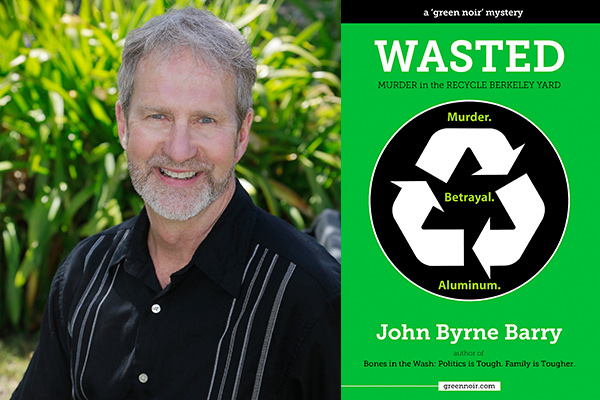 MURDER…BETRAYAL…ALUMINUM
A review of Wasted, a new novel about recycling set in Berkeley
By Daniel Knapp, Urban Ore
In John Byrne Barry’s second “Green Noir” mystery Wasted (the first was Bones in the Wash), a recycler in a company called Recycle Berkeley (Re-Be) is found mashed inside an export bale of aluminum cans at Berkeley’s transfer station. The recycler, one of Re-Be’s most passionate defenders, is dead. He didn’t get there by himself. Someone had to operate the baler, put him in it. Was it about Re-Be or was it personal? Who killed him? Who operated the baler?
At the beginning of the story, out and about on Berkeley’s gritty flatland streets at 5am, Brian Hunter temporarily escapes his boring day job as a contract bookkeeper to become a freelance reporter. His friend Doug, who drives a collection truck for Re-Be, has told him a small army of people are out every night stealing aluminum cans from Re-Be’s curbside routes. The financial impact is large. To follow the story, Brian decides to become a poacher himself. Doug gives him a route map so he can go in ahead of the collection trucks.
The first poacher he meets is unfriendly one moment, violent the next. Thinking Brian is a liar threatening his stash of cans, the poacher whacks the would-be reporter with a board. Brian howls in pain but doesn’t fight back. The two men take a break from these exertions for some talk over a couple of cans of warm beer the poacher has scored. Brian learns that poachers must have “sponsors.” This poacher offers to sponsor Brian. Brian accepts.
From then on, we’re in a strangely fictionalized but recognizable hall of mirrors that is the lot of people who actually do the work of collecting and processing all those cans and bottles. The author knows his stuff; he used to be on the board of directors of the nonprofit that does Berkeley’s curbside collection, although another nonprofit company processes the materials. In Wasted, they are merged.
Structural conflicts abound both in the novel and in real life. Poachers take the valuable aluminum and leave the rest for Re-Be. Income-deprived, Re-Be is sliding toward bankruptcy. Brian learns that Re-Be has fallen behind three months in rent to the City. He finds the politicians embarrassed and scared because Re-Be holds an exclusive City contract for curbside collection services. But City staff haven’t paid Re-Be’s service fees for months. A City Council member wants to hand Re-Be’s contract to another company. Re-Be’s managers and board battle desperately to keep the nonprofit afloat. Supporters, some armed with dubious tactics, flock to Re-Be’s defense in a press event and later in a big demonstration.
Consolidated Scavenger, a multinational waste company with a transfer station in a city to the south of Berkeley, is a big presence, willing and able to take over Re-Be’s contract. Consolidated, or “Con,” has friends in Berkeley’s high places but not so many on the street.
Just before Brian discovers the body of his friend Doug, he tells his editor how his story about poaching has morphed into something much bigger: “One power struggle mirrors another. At stake, a million-dollar…contract, the city council majority, and…the soul of Berkeley. Add sex and stir.” She says, “That’s not the story you turned in [yesterday].” Brian replies, “That’s right. But it’s the one you’ll get in two hours.”
Doug creates an upset by crashing and ruining a big celebration intended to help Re-Be. What he does leaves everyone embarrassed, confused and hating him. The unrest makes headlines around the world. As Brian tells it, “The media loves to trivialize Berkeley….many of the embryonic movements and trends nurtured here – from free speech to recycling to divestment from South Africa – have become mainstream, but the ‘only in Berkeley’ gibe never seems to go out of style.”
Besides losing the aluminum to poachers, Re-Be is losing some of its best workers to Con. Con pays better, but that’s not all. Some staff are fed up with the “kitchen-table collective” culture of Re-Be, so there are divided loyalties even before Doug’s death. The murder cleaves these loyalties into ever smaller bits.
Brian keeps following leads and trying to protect his sources while cooperating with the police, and we are carried along at a gallop. He loses lots of sleep staying just ahead of other writers who flock to the story. He falls in love with one of the female suspects and reflects on the proper relations between observer and observed. Cool detachment is impossible. He’s inside the story and outside it at the same time.
When the City tries to evict Re-Be, and when Re-Be refuses to go, the City breaks into its site at night and disables its baler. That break-in is one of the events that actually happened in Berkeley’s history. Moreover, a woman whose name begins with “K” (Kathy Evans in reality; in the novel she’s Kisa) finds a replacement part during the night, and the baler is up and running defiantly the very next day.
For fun, I made a list of all the direct parallels to the real story of Berkeley’s recycling. So far there are more than 20.
Which leads to a caution: beyond property damage, Berkeley’s recycling has never been marked by murderous violence. The skeleton of facts that Wasted assembles have been taken out of their actual context, rearranged, renamed, tilted and jumbled to serve the needs of the mystery, not history.
Recyclers have often had to defend their contracts and businesses. To resolve issues they have rarely resorted to demonstrations. Instead, they have written recycling-friendly laws and regulations that voters or City Council have strongly approved. For example, the first citizens’ initiative of three that were written all or in part by Berkeley recyclers stopped procurement on a garbage-burning power plant that City Council had already approved in concept unanimously. This citizens’ victory over their own electeds and the solid waste profession put Berkeley at the forefront of city or county burn-plant rejections that eventually totaled seven in our region alone, and hundreds around the USA. It also started a real-life multi-year no-holds-barred local political struggle. But no humans were mortally harmed.
For those already familiar with Berkeley’s tangled relations with its recyclers, Wasted can be an eerie and unsettling read. Others will enjoy learning a lot about recycling’s dark side while our hero reasons and guesses his way along a twisted trail to find the culprit.
# # #