Murder… Betrayal… Aluminum

Wasted By John B Barry_Slide_2MURDER…BETRAYAL…ALUMINUM
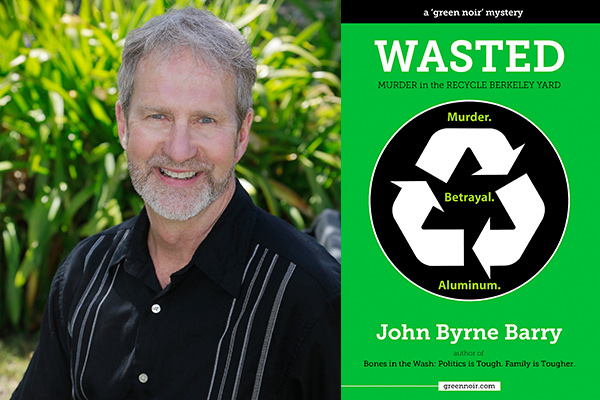
A review of Wasted, a new novel about recycling set in Berkeley
By Daniel Knapp, Urban Ore
In John Byrne Barry’s second “Green Noir” mystery Wasted (the first was Bones in the Wash), a recycler in a company called Recycle Berkeley (Re-Be) is found mashed inside an export bale of aluminum cans at Berkeley’s transfer station. The recycler, one of Re-Be’s most passionate defenders, is dead. He didn’t get there by himself. Someone had to operate the baler, put him in it. Was it about Re-Be or was it personal? Who killed him? Who operated the baler?

At the beginning of the story, out and about on Berkeley’s gritty flatland streets at 5am, Brian Hunter temporarily escapes his boring day job as a contract bookkeeper to become a freelance reporter. His friend Doug, who drives a collection truck for Re-Be, has told him a small army of people are out every night stealing aluminum cans from Re-Be’s curbside routes. The financial impact is large. To follow the story, Brian decides to become a poacher himself. Doug gives him a route map so he can go in ahead of the collection trucks.

The first poacher he meets is unfriendly one moment, violent the next. Thinking Brian is a liar threatening his stash of cans, the poacher whacks the would-be reporter with a board. Brian howls in pain but doesn’t fight back. The two men take a break from these exertions for some talk over a couple of cans of warm beer the poacher has scored. Brian learns that poachers must have “sponsors.” This poacher offers to sponsor Brian. Brian accepts.

From then on, we’re in a strangely fictionalized but recognizable hall of mirrors that is the lot of people who actually do the work of collecting and processing all those cans and bottles. The author knows his stuff; he used to be on the board of directors of the nonprofit that does Berkeley’s curbside collection, although another nonprofit company processes the materials. In Wasted, they are merged.

Structural conflicts abound both in the novel and in real life. Poachers take the valuable aluminum and leave the rest for Re-Be. Income-deprived, Re-Be is sliding toward bankruptcy. Brian learns that Re-Be has fallen behind three months in rent to the City. He finds the politicians embarrassed and scared because Re-Be holds an exclusive City contract for curbside collection services. But City staff haven’t paid Re-Be’s service fees for months. A City Council member wants to hand Re-Be’s contract to another company. Re-Be’s managers and board battle desperately to keep the nonprofit afloat. Supporters, some armed with dubious tactics, flock to Re-Be’s defense in a press event and later in a big demonstration.

Consolidated Scavenger, a multinational waste company with a transfer station in a city to the south of Berkeley, is a big presence, willing and able to take over Re-Be’s contract. Consolidated, or “Con,” has friends in Berkeley’s high places but not so many on the street.

Just before Brian discovers the body of his friend Doug, he tells his editor how his story about poaching has morphed into something much bigger: “One power struggle mirrors another. At stake, a million-dollar…contract, the city council majority, and…the soul of Berkeley. Add sex and stir.” She says, “That’s not the story you turned in [yesterday].” Brian replies, “That’s right. But it’s the one you’ll get in two hours.”

Doug creates an upset by crashing and ruining a big celebration intended to help Re-Be. What he does leaves everyone embarrassed, confused and hating him. The unrest makes headlines around the world. As Brian tells it, “The media loves to trivialize Berkeley….many of the embryonic movements and trends nurtured here – from free speech to recycling to divestment from South Africa – have become mainstream, but the ‘only in Berkeley’ gibe never seems to go out of style.”

Besides losing the aluminum to poachers, Re-Be is losing some of its best workers to Con. Con pays better, but that’s not all. Some staff are fed up with the “kitchen-table collective” culture of Re-Be, so there are divided loyalties even before Doug’s death. The murder cleaves these loyalties into ever smaller bits.

Brian keeps following leads and trying to protect his sources while cooperating with the police, and we are carried along at a gallop. He loses lots of sleep staying just ahead of other writers who flock to the story. He falls in love with one of the female suspects and reflects on the proper relations between observer and observed. Cool detachment is impossible. He’s inside the story and outside it at the same time.

When the City tries to evict Re-Be, and when Re-Be refuses to go, the City breaks into its site at night and disables its baler. That break-in is one of the events that actually happened in Berkeley’s history. Moreover, a woman whose name begins with “K” (Kathy Evans in reality; in the novel she’s Kisa) finds a replacement part during the night, and the baler is up and running defiantly the very next day.

For fun, I made a list of all the direct parallels to the real story of Berkeley’s recycling. So far there are more than 20.

Which leads to a caution: beyond property damage, Berkeley’s recycling has never been marked by murderous violence. The skeleton of facts that Wasted assembles have been taken out of their actual context, rearranged, renamed, tilted and jumbled to serve the needs of the mystery, not history.

Recyclers have often had to defend their contracts and businesses. To resolve issues they have rarely resorted to demonstrations. Instead, they have written recycling-friendly laws and regulations that voters or City Council have strongly approved. For example, the first citizens’ initiative of three that were written all or in part by Berkeley recyclers stopped procurement on a garbage-burning power plant that City Council had already approved in concept unanimously. This citizens’ victory over their own electeds and the solid waste profession put Berkeley at the forefront of city or county burn-plant rejections that eventually totaled seven in our region alone, and hundreds around the USA. It also started a real-life multi-year no-holds-barred local political struggle. But no humans were mortally harmed.

For those already familiar with Berkeley’s tangled relations with its recyclers, Wasted can be an eerie and unsettling read. Others will enjoy learning a lot about recycling’s dark side while our hero reasons and guesses his way along a twisted trail to find the culprit.

# # #

BOD Meeting Minutes, September 2015

NORTHERN CALIFORNIA RECYCLING ASSOCIATION

Thursday, September 17, 2015
Submitted by: Jennifer Cutter
Location: John Moore’s Office, 1970 Broadway Ave., Oakland

NCRA Board member attendees: President Laura McKaughan, Jessica Connolly, Doug Brooms, Jessica Robinson, Arthur Boone, Steven Chiv, Tomer Shapira, David Krueger, John Moore, Alex Hoffman, and Jennifer Cutter (arrived 6:50 p.m.).

NCRA Administrative Staff: Juliana Gerber

Guests/members/friends: Adrienne Gembala, Recology SF Operations

6:41 p.m. Call to Order

Board minutes from 6:41 to 6:50 recorded by Arthur Boone.
July minutes were approved as submitted. 10-0-0
Motion to approve printed copy of meeting agenda with amendments (added under Administrative Activity a letter for tax exempt status and for Actions Requiring Discussion/Policy decisions ATM card). 10-0-0

Treasurer’s Report

Financial Report for July/August 2015 (Robinson)

Treasurer Robinson presented the financials for July and August and reviewed major expense items. In July, NCRA awarded Gary Liss $1,000 for some zero waste work and conveyed $500 on behalf of ZWUSA to the Post Landfill Action Network (PLAN). In August NCRA received two grants from the EAB: $34,784 to fund multi-unit outreach in Oakland and $3,000 for materials Report accepted as distributed.

Administrative Activity

EAB Update (McKaughan)

The multi-family organics outreach in Oakland is going well. McKaughan and Robinson will be completing follow-up with property managers to get feedback on how the organics program is going/participation levels.

Update on archive project (Gerber)

Gerber is working with Heidi Melander to obtain more files. They are on a USB stick. Dan Knapp and Mary Lou of Urban Ore generously covered cost for scanning a large amount of files. There are 25 folders of documents and lots of subfolders on Google Drive. Archive dates back to 1983, but there are quite a few holes. David Tam also to review documents stored at Arthur’s house and submit those to Gerber for scanning.

Action Item: Gerber to produce for a content page for how the archive files are organized and what information can be found in there. When completed, this will be distributed to the Board and Directors can request to be granted read-only access should they want to see something.

Update on logo project (Gerber)

A survey was sent out September 2 and a reminder September 16. All board members need to complete survey. Brooms, Cutter, and Krueger still need to complete the survey. The deadline is Friday, September, 18.

Action Item: Brooms, Cutter and Krueger will fill out the survey by 9/18. McKaughan will update Brooms’s email address for the listserv so all his emails are going to the same place.

Letter for tax exempt status

McKaughan received an IRS letter indicating taxes weren’t filed and this could affect NCRA’s tax exempt status. These need to be filed as soon as possible and any monetary penalty paid.

Action Item: Hoffman agreed to call IRS to see what we need to do and she and Krueger agreed to help make sure NCRA’s taxes are filed promptly. Robinson will be kept in the loop so she can take this one for 2015.

Actions Requiring Expenditures

Donation to CRI – $500 (McKaughan)

NCRA board currently receives CRI member benefits such as webinar sessions and monthly newsletter. It is a very informative source and helps keep us up-to-date on recycling news.

Motion made by Boone to pay $500 donation to CRI for renewed 15-16 membership and Shapira 2nded. 11-0-0

Booth at Green Festival

Juliana reached out to Green Festival and woman she is working with is very proactive about trying to have us attend. A spot is currently held pending board approval to register, but we don’t know if location will be as good as before. Boone commented that he’s worked the Green Fest for Sierra Club and his opinion is that in both the case of Sierra Club and NCRA there needs to be something to grab people’s attention otherwise difficult to catch interest. Hoffman agreed and mentioned that spin wheel games tend to gather a crowd, especially kids. McKaughan said the NCRA members who staff the booth should have agenda laid out for what we want to accomplish so it is not a waste of time and money. Recycle for Change already has a booth and has offered to share it with NCRA.

Motion made by Boone to purchase booth at $475 in conjunction with Recycle for Change and Robinson 2nded. 11-0-0

Action Item: NCRA needs to pay our half to Recycle for Change since they already purchased the booth. McKaughan, Brooms, and Robinson can attend the Green Festival and potentially others. Gerber to inform Green Festival that we are sharing a booth.

NCRA picking up first round of drinks for SJ mixer

Mixer date set on Wednesday, October 21, starting at 5 p.m. Krueger generated a flyer and Sinnott advertised the mixer in newsletter. Focused on San Jose recycling folks to try and bring them back into the NCRA fold. Krueger says possibly 20 – 25 people will attend. At Market Bar in San Jose.

Motion made by Boone to cover drink expense not to exceed $200 and second by Krueger. 11-0-0 Krueger to look into bar and see if there is a happy hour or a way to limit this.

Actions Requiring Discussion/Policy Decisions:

Update on Mission/Purpose statement (Connolly)

McKaughan suggests perhaps change of using the term “systems” because it sounds more technology field geared. Moore sent out e-mail feedback regarding aligning the mission/purpose statement with the NCRA bylaws. Robinson thinks social/environmental justice should be included.

Action Item: Moore will send some more detailed comments to Connolly for inclusion and to be re-submitted to the Board.

Revisit the finances of ITR (McKaughan)

There is low registration for ITR so far. The cost is $45 per person. It is being held September 28 – 30. A small non-profit wants to send a different staff person each day, but that would not be beneficial because the course days build on themselves. Five to seven people is the cut-off and if number of registrants is not met it will need to be cancelled. ITR will be held at Recology’s Tunnel Rd. facility in San Francisco.

Action Item: McKaughan to send e-blast to Conservation Corps network. New updated text needed from Boone for the course. Robinson will see if USF students are interested.

3) ATM Debit Card for McKaughan & Gerber

Request made for additional debit cards in order to make NCRA purchases because McKaughan and Gerber have to apply very frequently for reimbursement. Krueger asked about card limits. Agreed that limit can be set to $500 in transactions.

Motion made by Boone to allow issuance of two additional debit cards to McKaughan and Gerber for NCRA account & second by Connolly. 11-0-0

Action Item: Robinson to contact Chase about issuing additional cards. Shapira would like to coordinate payment for the NCRA annual picnic with Robinson so he doesn’t have to separately apply for reimbursement.

Report by Committee

Zero Waste Advocacy

Report out from ZWAC meeting on Wed Sept 9

Brooms prepared memo regarding the final status of bills and reported out to group. The state’s legislative session has closed, so all letters now must be sent to Governor to encourage him to sign them. CAW appreciates that NCRA sends letters of support for bills furthering recycling and waste reduction measures.

Boone described a recent Fortune magazine article reporting on issues with curbside recycling including contamination, commodity market recession, etc. The article heavily relied on opinions of Waste Management CEO David Steiner which appeared to support local governments paying more to cover the cost the run curbside recycling programs instead of looking for other solutions.

Krueger wrote a draft letter to Fortune Magazine on behalf of NCRA. The letter was passed out for board to review during the meeting. Recycling markets are in recession right now and the article didn’t talk much about how to solve contamination issues, just emphasized that the WM single-stream method is the best out there. The reported focused on recycling losing money instead of looking at other revenue generating systems such as deposit programs.

Brooms will be leading the ZWAC committee for Boone over the next couple months while Boone is visiting the East Coast.

Motion made by Boone and second by Moore to have Krueger send the short version of Fortune response letter to reporter and long verson to Portia for newsletter with whatever edits approved by McKaughan and others. 11-0-0

Letters to be approved by Board

NCRA submitted letters in support of AB199, 751, and 1052. They also recently did letters in support of AB 876 and AB1063.

Request to adopt ZWIA definition of Zero Waste (Boone)

Ruth Abbe attended a discussed NCRA’s policy on definition of Zero Waste practices. The term “Zero Waste” has become very popular. Companies brand themselves as zero-waste to landfill when they are actually incinerating their materials instead of diverting as beneficial resources.

Motion by Boone to adopt as NCRA policy ZWIA definition of Zero Waste and second by Connolly. 11-0-0

Action Item: Brooms to draft policy letter and write something for NCRA news.

Suggestion for McKaughan to be point person for media

Moore says we need to connect with media sources so that they go to us as the experts instead of writers going to private haulers or other pro-waste entities. McKaughan receives a Google alert when NCRA important topics are in the news. She would prefer to know beforehand instead of after the fact by getting media contacts. No motion required, but board agreed that McKaughan as NCRA president should lead effort in being a liaison with the press.

Action Item: McKaughan to work on resurrecting/creating a media contact list for press releases and study up on how to talk to press – Moore has a resource to share.

Activities Committee

San Jose Mixer in October (Krueger/Chiv)

What should be the message to San Jose recycling group? It should be that we’ve noticed a drop-off in South Bay members attending events and RU conference. We would like to encourage and improve participation so our organization can include and represent interests of all regions in the Bay Area.

Picnic September 27 (Connolly)

Shapira and Connolly have conferenced to plan the member appreciation picnic. The location this year is further from BART, but should be a nice spot. Connolly prepared a flyer and distributed it to ZW Youth for promotion. The picnic will be at Lake Temescal in Oakland for third year in a row from 11:00 a.m. – 3:00 p.m. NCRA is partnering with the ZWYC. Also trying to develop a mentor/mentee program to encourage connections and will have a sign-up sheet available. Juliana received 8 member RSVPs and there are 10 board members confirmed as attending. ZWYC will put $100 toward event expenses. Set-up time is around 10:00 a.m. Come early if you are able to help.

Action Item: Shapira needs to separately itemize the ZWYC expenses from the NCRA expense, because money is kept in same banking acct so expenses will need to be itemized appropriately. Brooms will reach out to people who attend and are not members to help get them signed up. Juliana will bring a canopy in case needed to provide shade.

Next MF organics door-to-door outreach event (EAB grant project) on September 26 from 9 a.m. – 2 p.m. at Camp Arroyo Recreation Center in Oakland.

McKaughan and Robinson are participating. It is the same weekend as NCRA picnic and NCRA players’ cast party, so some people will be doing a lot of NCRA activities that weekend!

Potential tour of Safeway (Boone/McKaughan)

McKaughan learned that at Safeway’s Modesto facility there is not much to see. It is essentially a transfer point (separate and palletize materials) for transport to Vernalis site which is a Recology/Grover facility.

Action item: McKaughan will contact Tom Padia of StopWaste because he organized a tour of the Vernalis facility in recent past to try and get contact. Late fall/winter may not be a good time of year to go because if the weather and tour will take place outdoors. May need to schedule in springtime instead.

Cutter recommended potential joint board meeting and tour at AERC facility in Hayward on Thursday, November 19.

Action Item: Cutter to follow-up with AERC contact and update board via e-mail for input.

Membership Committee

Getting more LinkedIn followers

Action Item: NCRA has a LinkedIn page, please follow so that we can further promote. An e-mail was sent to board by Gerber July 28 describing how to properly set-up NCRA on your LinkedIn page. If you still need help please contact her.

Pilot mentorship program

Connolly would like to start a pilot mentorship program. Still needs to be developed. Parameters will likely be to just do a monthly check-in so not too great of a time commitment for either party. Connolly would like to add information about the mentorship program to the member letter and the membership registration/renewal on website with a drop-down menu so people can document if they are interested in being a mentor. McKaughan and Robinson volunteered to mentor. Connolly says we also need to find out from mentees what topics they want to know more about and what benefit they would like to see out of it.

Action Item: After picnic NCRA will have a better sense of the mentorship pilot and Connolly will share at next board meeting.

Newsletter Committee

Newsletter Chair, Sinnott was not present. McKaughan mentioned that the newsletter is looking great and the rest of board agreed wholeheartedly. Sinnott is remaining newsletter chair although no longer on NCRA board. Keep the newsletter article ideas/submittals coming!!!


Motion by Cutter and Connolly seconded to adjourn meeting at 8:46 PM.
Regulating Unstaffed Collection Bins

MOORE’S MUSINGS
A semi-monthly feature, exclusive to NCRA News, from NCRA general counsel and board member John Moore, concerning recent legal decisions relating in some manner to Zero Waste.

REGULATING CLOTHES COLLECTION BOXES

Another regulatory action designed to block recycling
By John D. Moore, NCRA Vice President and Legal Counsel, Henn, Etzel & Moore, Inc.
Oakland has now joined an ever-growing list of cities requiring a clothing bin collection company to obtain the written consent of the property owner, not the occupant, to place the box. I would bet not one staff member or elected of any jurisdiction imposing this law has ever tried to obtain consent of a property owner. These regulators don’t understand how difficult this process is. The result of this kind of ordinance is that there will be fewer clothes collection bins and less textile recycling, all directly in conflict with Zero Waste ordinances, County Measure D, and AB 939.

In my law practice I have negotiated well more than 50 commercial leases, usually representing the tenant/business owner. For a company desiring to place a clothes collection bin on a commercial premises, this is what they would need to overcome to obtain the property owner’s written consent. Please put yourself in the shoes of the clothes bin business and consider:

1. First you have to know who the owner is. The tenant may not know (especially if there is a property manager between the landlord and the tenant) or may not want to tell the box provider, leaving a search of the County assessor’s records as the only option left;

2. Even when you know the name and address of the owner, you don’t necessarily know who the contact person and/or decision maker is in that organization. It can take a lot of phone time to find the right person when you are cold-calling a business. The assessor’s records won’t tell you who to contact. The tenant in possession of where the box is to be placed may or may not know this information and may or may not be willing to provide it. Most commercial tenants want as little to do with their landlord as possible. Once a landlord knows that a tenant wants something (signed consent), it changes the landlord/tenant dynamic, and not for the good of the tenant.

3. Even if the clothes bin company ascertains the contact person for the owner, getting a signed consent is a formidable task. Landlords do not sign consents at will or whimsy. Landlords first wonder about possible liability, whether the tenant has insurance, whether this tenant is following the lease, and a host of other concerns, which often result in consent conditions being negotiated with the tenant, who has no vested interest in the outcome.

4. Even if the bin company finds a contact person willing to have the consent signed, many organizations have decision-making hierarchies that must be followed. Publicly traded REITs (real estate investment trust) own lots of commercial realty. As a publicly traded entity it has internal governance and regulatory rules it must follow before executing a consent.

Let me give one example: On my way to work each morning I pass a Chevron station on Grand Avenue in Oakland that has a box owned by US Again. Let’s say I need to get the owner consent to place that bin. In trying to get the property owner address, I can fairly assume three things right away: 1) the occupant is a franchisee of Chevron; 2) the occupant likely has no relationship with the property owner- leases are typically negotiated directly by the franchisor; and 3) the person on duty operating the Chevron during the day is unlikely to be the franchisee. So, I have to find out the contact information for the franchise holder and ask them to ask their franchisor for the property owner contact information. Why would the franchisee want to help? There is no real benefit to the franchisee in asking for something from the franchisor. Even if I got the franchisor contact information, why would the franchisor want to give me the contact information for the property owner? They wouldn’t. They have no stake in placing a collection box.

It used to be that one could find out the name of the property owner online via the Alameda County Tax Assessor. No longer. You must go to the office in person to do so. I spent 30 or so minutes trying to find ownership information through a private service, giving out my contact information in the process so I could get spammed later, but was unsuccessful and gave up. I could pay a service to find the information or I could go in person to the Tax Collector office to search for ownership but in either case I would not be much closer to satisfying the regulator.

Even if I were to get the owner’s name and billing address for the tax collection (what a private service is likely to find), I would have a long struggle from there to find the business office for the owner and talk my way to a person who could tell me who needs to sign a consent for the placement of the bin. Now the hardest part yet is to convince that person to give a signed consent.

Needless to say, this process of collecting a property owner signature requires a huge time commitment and amount of diligence for a bin company just to place one box. The result will be the placement of fewer boxes. That result means less textiles are recycled and more textiles are landfilled, an outcome that conflicts with established state policy.

I have no quarrel with wanting these collection boxes and commercial premises to be kept clean and clear of blight. I also have no quarrel with regulation of financial responsibility of both the bin company and the tenant in possession. Regulation of these aspects of clothes collection does not require onerous and recycling-diminishing laws that require a paper signature from a property owner as a condition of placement of the bin. Requiring a signed consent from the occupant of the property and permit conditions about blight and insurance should be satisfactory protection for the city.

All the owner-signature requirement does is create a huge barrier to entry of the market, reduces recycling, and grants economic protectionism to the advocates of this law, Goodwill and Salvation Army. This should be off limits to regulators.

Marine Plastics Washed Ashore; An Opportunity?

By John Hanscom, John T. Hanscom Consulting
On a recent visit to Roatan, Honduras, I was staying at a seaside resort. One evening I took a walk along the shore and began to gather plastic along the way. A lot had accumulated so I asked the hotel for large plastic bags to help with my efforts. I collected two bagfuls of plastic that first evening and three more over the following two days.

The main types of plastic that had washed up were beverage bottles, nets, marine foam from buoys and other flotation equipment and, interestingly, a considerable number of sandals and flip-flops. Bottles were a particular problem because some were so brittle that they would shatter with the slightest pressure. I had to put many carefully into the bag with both hands to keep them from crumbling into small, unrecoverable pieces.

The potability of tap water from island wells is variable, so upon check-in guests are given three bottles of water, labeled with the name of the resort as a promotional item. Three more are waiting in the guest room. Every day, housekeeping provides three new bottles. Each of the 80 occupied rooms receives 24 bottles in one week. That’s potentially 100,000 bottles a year!

I brought this problem to the attention of the resort general manager. I made the contrast between his manicured, man-made white sand beach lagoon that is cleaned daily by his staff and the plastic-littered shoreline on the other side of the protective seawall. I suggested that he perhaps dedicate one of his lagoon clean-up staff to walk along the shoreline and gather up plastic twice a week. Furthermore, I encouraged him to challenge his neighboring resorts along the coast to do the same.

The plastic that I cleaned up was mainly in front of the resort where I was staying. But the plastic litter continued on all the way up and down the coast. Where the plastic contamination stopped was at a resort up the coast that does clean its shoreline and, instead of providing water bottles each day, they provide reusable drinking containers to be refilled at water stations around their property.

I mentioned to the general manager the perceived environmental liability that comes from contributing to the contamination of the very shoreline that tourists travel from around the world to enjoy. I acknowledged that the majority of the plastic was not from his resort, and possibly much of it was not even from the island itself.

Collection of these caches of shoreline plastic seems like an opportunity to directly impact marine debris in an effective manner. It would also allow this and other resorts to be part of the solution to reducing marine plastics by demonstrating that they are preserving the very resource/attraction that tourists come to see.

WHOIS: John T. Hanscom is an environmental planner with over 20 years of managing and implementing waste reduction, recycling and organics programs. His experience as an MRF operations manager, public sector recycling program manager and independent consultant includes all levels of outreach and education, discard characterizations, C&D facility assessments and compliance with mandatory recycling ordinances. He is also trained to provide EnergyStar Benchmarking for commercial buildings and evaluate energy conservation measures. He is bilingual in English and Spanish.

NCRA Response to NYT’s Op-Ed

Dear NYT Editors:

When the CEO of Waste Management, one of the largest haulers and landfill operators in the world, serves as the sole industry representative consulted about the future of recycling, readers can rightfully suspect they’re not getting the full story. In John Tierney’s Op-Ed piece, “The Reign of Recycling,” the irony of the question, “Is recycling wasteful?”, is that “waste” is what happens when discarded materials are not appreciated for the value they represent to our economy as the building blocks for new products.

The answer to his question is quite simple: No, recycling is not wasteful, but given his way, Tierney will do what he can to ensure that’s where it’s headed. Instead of cherry-picking “facts” that downplay the significance of recycling 10 of billions of beverage containers or the impact of avoiding thousands of tons of greenhouse gases being emitted through recycling food scraps, he implies it would be better to throw them out because it takes too much time to sort them!

Why not call for products that are more easily recyclable or made from component parts to aid in the recycling process? Why not build more recycling infrastructure within the U.S. to avoid the volatility of global markets?

The Northern California Recycling Association, a 37 year old recycling trade association working to promote waste diversion, recycling and Zero Waste, welcomes the opportunity to provide an alternative viewpoint painting a truer picture of what is happening in the recycling movement than that offered by Mr. Tierney and the landfill industry he seems to be supporting.