Knapp: Trashy Opinions Again From John Tierney

By Daniel Knapp, CEO of Urban Ore, Inc., a Materials Recovery Facility now celebrating its 35th year in Berkeley, California,

To the Editor:

I’ve been a full-time operator of a well-known reuse and recycling business for 34 years now. Lots of people have been at it longer.

Some years back, your paper featured my company as an environmental success story. We’re open 360 days a year, still doing fine, thank you. All around us are others who are doing quite well, too. Our biggest problem is keeping up with the ever-growing demand for our services and products.

It’s easy to see why John Tierney gets this all wrong in his October 6 piece “The Reign of Recycling.” He didn’t talk to any of us.

Instead, he talked with the head of Waste Management, which last year landfilled over 90 million tons of resources it says couldn’t be recycled. It’s a little hard not to feel sorry for this CEO. His company owns nearly 200 landfills, and landfills compete with recycling for supply. This builds in a kind of corporate schizophrenia. Gains in recycling mean losses in landfilling. What a conundrum! Adding to the big waste companies’ problem is the fact that they have made bad investments in recycling technology, which require poor countries to accept mixed-up machine-sorted trash. Then the poorest people hand-sort it. But the biggest of these countries, China, put up a “green fence” two years ago that excluded these dirty products. Bales backed up in US warehouses. Stuff processed as resources now had to be wasted. No wonder costs for recycling went out of control!

Too bad for him. That market contraction didn’t happen to smaller and more nimble companies that produce high-quality feedstocks.

He doesn’t mention that as of 2004, there were 56,000 individual materials recovery businesses in the USA generating over $220 billion in income. We’re more numerous now, and we compete with big waste companies for supply. Likewise, he doesn’t mention that where I live, surrounded by more than 7 million people in more than 75 cities, recycling rates of 75% and better are commonplace. The supply of resources going to landfill is drying up.

How do we do this and stay solvent? Good question. But you won’t get any answers from Mr. Tierney. He says we have to be “subsidized,” whereas wasting receives service fees. There is no difference, except that we are cheaper. Our formula for success is: service fees + product sales = solvency.

America Recycles Day Letter To Recycling Businesses, 2014

The 18th Annual “America Recycles Day” (ARD) will be on November 15, 2014.  ARD is the only nationally recognized day dedicated to encouraging Americans to recycle and buy recycled content products.  Since 1997, the ARD campaign has grown to nearly two thousand events, with more Americans pledging to increase their recycling habits at home and work.

There is no better opportunity to draw attention to the nation’s woeful consumption and discards habits that America Recycles Day.  According to the US EPA, in 2012, Americans generated 251 million tons of Municipal Solid Waste (MSW), or 4.38 pounds per person per day.  Included however are 65 million tons of recycled and 21 million tons of composted materials, for a total diversion rate of 34.5%.

For 2012, the manufacturing of products to include reclaimed materials had saved our nation 1.1 quadrillion BTUs of energy (enough for 10 million households per year), and avoided 168 million metric tons of carbon dioxide equivalent (equivalent to removing 33 million passenger vehicles from our roads per year).  The reduction in greenhouse gases (GHG) are beneficial towards global warming and climate change.  Additional benefits of recycling include the creation of jobs, pollution reduction, conservation of virgin materials and natural resources, and preservation of landfill capacities.

The Northern California Recycling Association (NCRA) is a non-profit organization with about 200 members, mostly throughout the Bay Area, representing a broad spectrum of the recycling community.  NCRA promotes waste reduction, reuse, salvaging, recycling, and composting as vital tools for resource and energy conservation, and as cost-effective, environmentally sound methods of disposing of discarded materials.  We support America Recycles Day, and have taken the online pledge and encourage others to take pledges likewise in solidarity.

In the short time remaining, consider whether your business and employees would be willing to also take pledges to help expand public awareness, underscore the importance of and the many benefits of recycling, and to recommit the role of your business.  You’ll find a link to the pledge and a partial listing of Bay Area ARD events at our web site www.ncrarecycles.org.

Whether or not your organization will support or participate in an ARD event this year, thanks for your ongoing efforts to help transform the public from the garbage as usual paradigm, more towards a zero waste mentality.  Thanks for sharing this with others.
Sincerely,
Laura McKaughan, President
NCRA Board of Directors
www.ncrarecycles.org  ncrarecycles@gmail.com

European Waste Picker Organizing Begins

Trans-European Waste Picker Organizing Begins

By Portia Sinnott, NCRA Editor and SpringLoop Cooperative, 09/8/2015
The first European Waste Picker Meeting was held September 7 in Antwerp, Belgium. The organizers included Netherlands-based global recycling specialist Anne Scheinberg of Springloop Cooperative, Serbian innovation specialist Jelena Nesic of DTI, Pietro Luppi and Sevla Sejdic of Occhio di Riciclone (the eye of the REcyclone (OdR) and Paddy Noë of Noë Waste Measurement Consultants (NWMC), the one day informal recyclers meeting was held in cooperation and in parallel with the annual International Solid Waste Association (ISWA) conference.

The goal was to open the channels of communication between the informal recyclers and re-users and the formal solid waste establishment. This meeting was a first step and went well. At the 2016 ISWA conference in Novi Sad, Serbia, a series of panels are already planned devoted to this topic, and there will be an invitation and space for many more European waste pickers, and their Asian and Latin American and African counterparts, to attend.

Twenty-seven people participated in the waste picker meeting. Informal recyclers and reuse entrepreneurs came from Paris, France, Rome, Italy and Belgrade, Serbia plus three generations of one Hungarian family. Most informal recyclers and re-use entrepreneurs in Europe are from Roma ethnic groups – sometimes known as gypsy people. The organizations that were represented from France and Italy also have a social development and job creation mission.

Also taking part was Mr. Alphan Eröztürk, President of the Turkish EPR organization CEVKO – Environmental Protection and Packaging Waste Recovery and Recycling Trust, representing the European Extended Producer Responsablity Alliance, EXPRA. Advocates and “others” included action researchers and practitioners from Brazil and India plus ISWA Young Professionals from the US and Brazil. It was a pleasure meeting all of these people, especially translator extraordinaire Sonja Barbul of Belgrade, Serbia, who juggled seven languages using a simple mobile microphone system with individual receivers. It really helped to be able to hear clearly.

Two interrelated topics were brought up again and again and again during the meeting – lack of legal identity papers, and the right to collect, process and/or sell recyclables and reusables without fear of police harassment. Roma people in particular are frequent victims of discrimination, and, for historical and cultural reasons, are often outside of all legal systems. Picking waste gives them an honest way to support their families, but closing spaces for informal activity sometimes put them on the wrong side of new EU-stimulated waste laws.
At the same time waste management systems around Europe are becoming more and more formalized and rigid, and private sector participants of all sizes must meet certain requirements.

In some countries this creates for informal recyclers, a cascading series of double binds. In France it is possible for anyone to collect discards but selling it may be difficult depending on the jurisdiction. In Paris – but not in Montreuil, an adjacent city, reuse business people may be chased away from the market where they are displaying cleaned and repaired goods. In Hungary, bulky goods are legally imported by semi-formal traders, from richer waste streams in Austria and Italy. Even when informal re-users are given goods and furniture by their owners, they can be accused of stealing from the waste management companies, and prevented from keeping or selling the items. In Rome, pickers can have a days’ work confiscated and given to the formal service provider, or trampled and thrown back in a dustbin before their eyes.

Serbian law prohibits private collection of discards but the law is generally not enforced. One company picks up plastic from 300 businesses and gives them new plastic bags in return. Even though no money changes hands, a vehicle hauling a large load may be pulled over by the police and the driver asked for identity papers, permits or other documents to which informal entrepreneurs seldom have. The authorities may be “so nice” as to let the re-use traders go – if they leave behind a fat bribe. Storage and processing can be a serious challenge as well. In some cities, buyers pay informal recyclers less than the market price because they know they can’t complain.

The most restrictive, anti-re-use statute is in Austria, there waste management companies are paid by the ton for what they pick up and therefore consider all other activity to be stealing their money. If you have used items in your house set aside for the flea market or for giving away, these materials legally already belong to the local authority, just based on your intention.

In California discards placed in recycling carts generally belong to the jurisdiction or service provider. Everything else is up for grabs. Anyone can sell to a buy-back, donate to a non-profit, give goods away or put them out for whoever comes along. Litter belongs to whoever picks it up. Flea markets and reuse businesses may be a different story since they have to report sales to the state. (No businesses or buy-backs I am familiar with discriminate on legal status. If you know of a situation where non-residents are ill-treated in this regards, please let me know. I will not quote you.)

The report will be posted in a few months… Springloop: www.springloop.nl, and www.dti.org.rs

Editor’s note: For the curious, my tasks for this project included assisting with pre-event organizing, welcoming and assisting participants, casual translation utilizing my rudimentary German – the only language the Hungarians spoke other than Hungarian and Roma, taking detailed notes and writing the draft report. I hope to take part in next year’s meeting in Serbia.

Masonic Homes’ Composting Tour

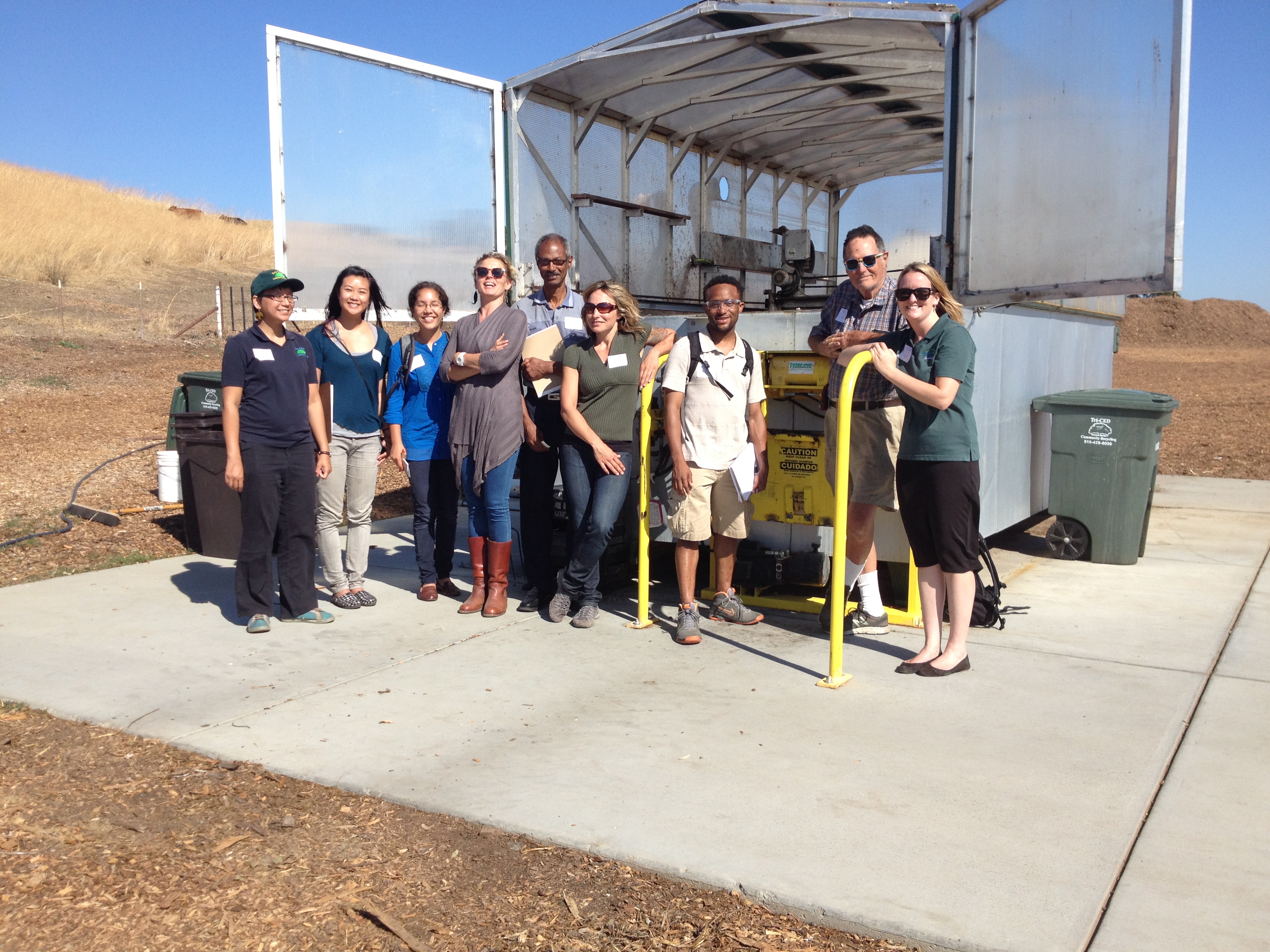
Masonic Homes Photo JC1NCRA Tours Masonic Homes’ Innovative Composting and Woodlands

By Nicole Gaetjens, Sustainability Coordinator at Mills College and Ellen Hopkins, Zero Waste and Composting Consultant

NCRA members Ellen Hopkins and Nina Salvador and Tri-CED Recycling employee Raquel Archuleta led eight other NCRA members on a tour of an on-site composting system in July. Located on 250 acres in the hills of Union City, Masonic Homes is one of the largest assisted living facilities in Northern California. Masonic Homes and the neighboring facility – Acacia Creek Retirement Community, have partnered with Tri-CED Community Recycling for over three years to compost all food discards generated by 600 full-time residents and staff in an on-going effort to increase sustainability at the site. The compost produced is being used for an innovative habitat restoration project led by Math Science Nucleus (MSN) to restore native California flora to the hillside of this Mission Hills property.

The Earth Flow is made by Green Mountain Technologies. Ellen Hopkins, composting consultant, and Raquel Archuleta explained the collection flow, in-vessel compost process and operations. Raquel collects prep (pre-consumer) and dining (post-consumer) food waste daily in four to five 64-gallon containers and brings it to the compost station. The compost system has a tote-tipper that tips each container into the loading end of the machine and an electric auger mixes the material into the existing compost in the system. Food scraps (nitrogen source) are mixed with equal parts of bulking agent (carbon source) in the system to produce a C:N ratio that makes the composting process effective. Daily input of food waste is about one ton or two yards, and bulking agent is about ½ ton or 2 yards. The bulking agent(s) used in this case is horse bedding from a neighboring horse stable and chipped wood waste from landscape maintenance on the property. The NCRA group checked out the compost in the vessel and were surprised there was no noticeable odors.

The Earth Flow is a fully automated, fully contained, in-vessel composting system that provides optimum conditions for thermophilic composting. The auger, aeration and moisture addition systems are programmable for process and product objectives. The traveling auger mixes in the new feedstock at the load end. The new material is quickly inoculated with active composting microbes as it is blended in. Process air above the compost in the vessel is pulled through a biofilter next to the Earth Flow. The biofilter is composed of moistened woodchips. Microbes that normally inhabit woodchips (no inoculants needed) scrub odors and volatile organic compounds (VOCs) with 95% efficiency. The “plug flow” matrix migrates to the discharge end over the course of 2-3 weeks. In-vessel time depends upon the amount of material loaded and system size. After processing within the vessel, the compost is unloaded and cured to completion outside of the vessel within 6-8 weeks.

Nina Salvador, who is familiar with the reforestation project, described it in more detail: Masonic Homes and partners aim to restore the native oak woodland that once inhabited this region prior to the over grazing of cattle. The woodland will provide ecosystem services and enjoyment to the community. Nearby California State University-East Bay faculty and students are also involved in the restoration effort led by Joyce Blueford of MSN. This closed-loop system demonstrates a win-win-win project and was a great tour for the NCRA group.

WHOIS… MATH SCIENCE NUCLEUS is a 33 year old national and international educational and research non-profit composed of scientists, educators and community members. Locally it is associated the Children’s Natural History Museum in Fremont. It serves as an online science resource center to assist school districts, teachers, and administrators around the world. The major goal is to develop problem solving capacity through science for the world’s children. Read more… MSN: http://msnucleus.org/

ZWAC Minutes, September 2015

NORTHERN CALIFORNIA RECYCLING ASSOCIATION ::
ZERO WASTE ADVOCACY COMMITTEE
MINUTES OF MONTHLY MEETING, September, 2015   DRAFT.

This meeting was held on Wednesday, September 9, 2015 at the offices of John Moore, 1970 Broadway, 9th floor, Oakland. Called for 6 p.m. Call-in number is 510/891-9800.

Present were Chair Boone and committee members Abbe, Brooms, Hoffman, Krueger, McKaughan, Moore, Wright and Yee; no call-ins. The meeting started at 6:07 p.m. Minutes of the August meeting were not discussed. Boone served as secretary.

NCRA POLICY ON ZERO WASTE: Abbe, presenting. There is currently a large conflict within the WR&R industry with many different ideas about what should be acceptable Zero Waste practices. NCRA has never formally adopted the ZW International policy statement and it was moved (Abbe), seconded (McKaughan), and voted (unanimous) that the NCRA board do so. Boone suggested that the NCRA board defer action until October as the NCRA News would not be able to include this matter in its September issue but, after some discussion, that idea was withdrawn.

PROPER MANAGEMNT OF CARTONS AND ASEPTICS: Abbe, presenting. She has been working in several different school districts in Alameda County and each has a different practice because its local public agency’s contract with Davis Street MRF varies so that some USDs teach kids that aseptics are not recyclable and others teach that they are. Tom Wright contributed a lot of detailed information about aseptics, the more advanced sorting machinery available in Southern California MRFs, etc. It was agreed that Wright will write up some background on this issue and suggest what can be done.

LOCAL CO-SPONSORS FOR THE ELLISON ZW BILL IN THE CONGRESS: Boone, presenting. Boone suggested that he write on behalf of NCRA to all Bay Area congresspersons suggesting that they co-sponsor the Ellison bill, agreed. Boone to execute.

TEXTILES AT CAL RECYCLES: Hoffman, presenting. At the CR public event in March, it was revealed that the agency has no detailed knowledge of the disposition of textiles (Hoffman says 85% go to landfill) and seems to have no plans to learn or do anything else. She asked that NCRA directors write CR on this matter; McKaughan reminded the ZWAC members that the 48 hour review period required of board actions would cause any such letter to miss the Friday at 5 p.m. deadline. Boone offered to write his own letter.

FORTUNE MAGAZINE ARTICLE ON CURBSIDE’S DIRE STRAIGHTS: Boone, presenting. It was widely agreed that the article’s heavy reliance on David Steiner’s mission (to shake more cash out of the local governments who pay his firm to run curbside programs) was transparent. Wright likes TOXIC SLUDGE IS GOOD FOR YOU, a book that details how big business twists the public’s perception of environmental issues. Kruger will draft a response of the NCRA board to the Fortune article and have it passed around for improvements and approvals.
FEEDBACK TO THE ASSEMBLY WASTE REDUCTION AND RECYCLING COMMITTEE: McKaughan, presenting. She was present on August 18th when Assemblyperson Gordon’s committee met in Sacramento to take testimony about how the future could be better than the past. Gary Liss was present and recommended that the state adopt a Zero Waste goal. After some discussion, it was agreed that McKaughan should draft a similar letter for NCRA to sign onto.

VIRTUE IN THE NEW OREGON WR&R LAW: Boone, presenting. He had heard that the new Oregon law relied heavily on life cycle assessments to determine work programs of which he had an instinctive distrust; Wright said he had discussed these issues with David Alloway (Oregon DEQ) on several occasions and found that the results of any such study were too much a function of what assumptions were made. No further action.

OUR OWN WORK ON OUTSTANDING BILLS. Brooms, presenting. NCRA did get its 199, 751, and 1052 letters in; Krueger thanked Brooms for seeing these letters out the door.

CLOSING UP: Boone indicated he is going back east in early October for two months or more;  Yee volunteered to be secretary.

Adjourned at 7:43 p.m.

Next meeting should be on October 14th; location TBD.

Respectfully submitted, Arthur R. Boone, Acting Secretary